
Logging in for ten free spins a day: what the bonus really does to the wagering counter
A daily free spins offer at a UK casino reads as the lightest promo in the catalogue: ten spins, no deposit, log in, play, on with the day. The arithmetic behind it is the same as any other bonus — credited as bonus funds, subject to wagering, capped at ten times its value before any withdrawal is permitted. What follows walks through what that arithmetic costs the player, who is licensed to offer it, how the rules around it changed in December 2025, and which ten operators on the Gambling Commission’s public register run a daily-spins product at all.

Current as of 7 November 2026 · checked against the Gambling Commission’s public register of gambling businesses
Table of Contents
- The Gambling Commission’s jurisdictional reach over UK daily free spins
- Player protection that the licence pulls with the offer
- Money in and money out at a UKGC-licensed casino
- A daily free spins incentive and what the 10x cap actually does
- Ten licensed brands and how their offers line up
- Ten UKGC-licensed brands running a daily-spins product
- The fundamentals of licensed daily free spins in the UK
- Common questions on UK daily free spins
The Gambling Commission’s jurisdictional reach over UK daily free spins
No casino is allowed to put a daily free spins offer in front of a British player without holding a Gambling Commission licence. That sentence reads as obvious; it carries more weight than the marketing around it suggests. Since the Gambling (Licensing and Advertising) Act 2014, any operator taking customers in Great Britain needs a Commission licence wherever it is actually based — a Curaçao, Malta or Gibraltar registration is not a substitute, and a domain routed through offshore payment processors does not lift the requirement. The Commission’s own register is the only test of whether a brand holds one.

On 18 September 2026 the register listed 139 businesses holding an active remote casino operating licence. The licence number itself follows a fixed shape: account-R-number-suffix, where the first six digits repeat the licence holder’s account number and the R marks a remote, online licence. Examples from the operator list include 054743-R-330863-014, the LC International licence that runs both Coral and Ladbrokes, and 039576-R-319370-028, BV Gaming’s number behind BetVictor. Each licence maps to one or more active domains — the register’s domain list held 1,065 active entries on the same date, plus 361 white-label sites that trade under another company’s licence.
The white-label number matters here. A site running on a white-label agreement is licensed, but its owner is not the entity that holds the underlying licence — it operates the storefront, the payment rails and the marketing, while the licence lives with a larger operator whose compliance team handles the regulatory work. Players see a brand name on the page; the register sees a different one. Among the ten brands featured below, several share a single licence account: Ladbrokes, Coral and Gala Bingo all sit under LC International, which is the cleanest worked example of that arrangement on the register.
What an operator cannot do without one is set out in section 33 of the Gambling Act 2005: offering gambling to people in Great Britain without a Commission licence is an offence. The Commission’s enforcement record runs through cease-and-desist notices, payment and hosting referrals, and search-engine delisting. It has no statutory power to block internet service providers — the ISPs themselves have, at times, agreed to voluntary blocks — but the regulator’s tools extend to chasing the financial plumbing that props an unlicensed brand up. None of that pressure is aimed at the player. What the player loses by playing on an unlicensed site is a different category: the protections that come with the licence.
The rules attached to a UK remote licence shape the offer rather than let licensees choose. Online slots carry a maximum stake per game cycle — £5 for players aged 25 and over from 9 April 2025, £2 for 18-to-24-year-olds from 21 May 2025. Auto-play is banned. A single spin may not resolve faster than 2.5 seconds. Losses disguised as wins — slot animations that celebrate a return smaller than the stake — are also banned. Since 31 October 2025 every licensed operator must prompt a customer to set a financial deposit limit before the first deposit, an acknowledgement rather than a refusal (a player can choose zero, but the prompt has to happen). The combined effect is that the slot experience at a UK-licensed casino looks and feels different from the offshore version, and that difference is intentional.
A note on geography: the Commission’s remit is Great Britain — England, Scotland and Wales. Northern Ireland runs under separate legislation. Players there will find that most major brands operate against the GB register rather than a local one, with the practical consequence that the offer’s regulatory floor is set by a body that does not formally cover them. Brand-side terms pages typically inherit the stricter of two regimes the operator holds, but a Northern Irish reader signs up against an adjacent regulator and should read the small print.
On the tax side, players pay nothing on gambling winnings in the UK. The operator pays Remote Gaming Duty, and that rate rose from 21% to 40% of gross gaming yield from 1 April 2026. The duty is not a player cost, but it lands in the offer’s economics. A higher duty compresses margin, and the usual industry response is to tighten the promotional side rather than the headline price. That is a separate mechanism from the wagering cap, but the two forces bend the same set of offers in the same direction.
Player protection that the licence pulls with the offer
Every daily free spins offer a UKGC-licensed casino publishes carries a tail of player-protection measures the offer’s headline ignores. Reading those into the offer is what separates a licensed brand from one that runs from somewhere else, and the gap is larger than the marketing language around it suggests.
GAMSTOP is the backbone of the protection layer. Since 31 March 2020, taking part in GAMSTOP — the national online self-exclusion scheme — has been a mandatory condition of every online gambling licence. A player registering with GAMSTOP chooses a six-month, one-year or five-year exclusion; once registered, every operator on the Commission’s register is required to refuse to open or to continue to serve that account. The exclusion cannot be shortened or cancelled early. Finishing the period does not mean automatic reinstatement, and a cooling-off period runs before any new account can be opened. For a player who registers on a Monday morning, even the £0.10 of a daily free spins offer is held back for the whole period.
Identity verification has run since 7 May 2019. Before the first deposit or any play, a UK-licensed operator must verify name, address and date of birth. The point is to enforce the minimum age of 18, but the underlying check pulls in a broader range of public data. Since 28 February 2025 the operator must additionally run a financial vulnerability check at the point where a player has deposited a net £150 across the previous 30 rolling days. The check runs against public data only at present; more invasive checks are announced but not yet in force. The prompt is not there to take money off the player — it is there to flag a pattern of escalating deposits and offer a follow-up, a time-out, or a signpost to support.
The Commission has not set a default deposit or loss ceiling, and it has said it will not. What it has done is require that every player be offered a chance to set one before the first deposit, and operators must respect deposit limits once set — reducing a limit typically takes effect immediately; raising one usually involves a 24-hour cooling-off period and a re-prompt. Time-out, reality-check intervals and self-exclusion at operator level sit alongside the GAMSTOP route. None of these tools recovers money already lost; they shape the boundary in front of which the next bet has to land.
When a dispute cannot be settled with the operator, the Commission’s approved alternative dispute resolution providers — IBAS in most cases — handle it. For ongoing harm, GamCare runs the National Gambling Helpline, and GambleAware funds treatment and signposts. None of these routes exist on a site that operates outside the licence.
The figures on the unregulated side tell the story obliquely. The Commission estimated around 800,000 UK consumers used credit cards to gamble in 2018 — a number large enough to be one of the trigger conditions for the credit-card ban that followed in 2020 — and 22% of online gamblers who funded play with credit cards were classed as problem gamblers. Both estimates pre-date the 14 April 2020 ban itself.
What a player loses by choosing an unlicensed site is exactly this layer. No GAMSTOP cross-check. No deposit-limit prompt. No vulnerability check at £150 net deposits. No ADR route. No Commission complaints procedure. The game looks the same on the page. The shape of the platform around it does not.
Money in and money out at a UKGC-licensed casino
The mechanics of funding a UKGC-licensed account and pulling winnings back out have their own legal floor, and several of the old routes have closed. The shape of the payment side tells you, as much as the licence page does, whether a casino is really operating against the British register.
The credit-card ban took effect on 14 April 2020 and covers online and offline gambling across Great Britain — apart from non-remote lotteries paid for face-to-face, which fall outside the rule. The ban applies even when the credit card is held inside an e-wallet: routing Visa or Mastercard credit through PayPal, Apple Pay or AstroPay does not lift the prohibition. Debit cards and bank transfers remain unaffected. The rule was a direct response to the Commission’s 2018 finding that 22% of online gamblers funding play with credit cards were classed as problem gamblers — a finding that, two years later, became the trigger for the ban that took effect across online and offline gambling in April 2020.
Debit cards, then, are the everyday funding route. Apple Pay sits on top of them. Tokenisation replaces the actual card number with a device-specific Device Primary Account Number, and a dynamic security code is generated for every transaction. Launched in the US in October 2014, Apple Pay began supporting UK-issued cards in July 2015, runs over near-field communication at the contactless terminal, and authenticates an in-store purchase with a double-click of the side or Home button depending on the iPhone model. The point for online gambling: an Apple Pay deposit looks like a debit-card deposit to the casino, settles through the card rails, and inherits whatever limits the card issuer sets. A card issuer can refuse a transaction if the casino’s MCC code flags it, but Apple Pay’s tokenisation sits in between — the casino never sees the underlying credit number, only the device token.
AstroPay’s UK footprint is regulated rather than directly tied to the card networks. Larstal Limited, AstroPay’s UK entity, holds electronic-money institution authorisation from the Financial Conduct Authority under the Electronic Money Regulations 2011, and the wider AstroPay group is regulated for money transmission in multiple jurisdictions — Isle of Man, Brazil and Denmark among them. For a UK player the practical implication is that an AstroPay-funded deposit is a payment-institution transfer rather than a card transaction, and the casino’s settlement journey goes to that company rather than to Visa or Mastercard.
Bank transfers inside the UK route through the Faster Payments Service, launched in 2008 and running 24 hours a day, seven days a week, operated by Pay.UK. Most Faster Payments arrive instantly or within a couple of minutes; the scheme allows up to two hours in unusual cases. The per-transaction ceiling is £1,000,000, though individual banks typically set lower customer-facing limits. Faster Payments covers the bulk of UK withdrawals — a casino paying out by bank transfer typically reaches a current account the same day, sometimes inside five minutes. The Bank of England does not run the service day to day, but it oversees the system’s safety and provides the final settlement that closes each day’s cycle.
A casino that uses any of these routes will not accept an e-wallet funded from a credit card, and will reject one that turns out to be. An unlicensed one operates on a different set of rails. That is the practical division: the regulation shapes the payment side as much as it shapes the bonus.
A daily free spins incentive and what the 10x cap actually does
The marketing word for these offers is “free.” The arithmetic word is 10x. The slot’s word is whatever its return-to-player reads at, and that figure sits below 100% by design. A daily free spins bonus lives inside all three numbers at once, and the reader who treats the offer as weightless risks doing exactly that.
A daily free spins incentive at a UK casino is built around a small, repeating bonus credited automatically when a player logs in. Most are ten to twenty spins at a low stake — typically £0.10 or £0.20 per spin — on one or two named slot titles, sometimes on a single title with the stake pre-set. The “no deposit” tag is correct: no money changes hands before the spins run. The “free” tag is more qualified. Spins return winnings as bonus funds, bonus funds carry wagering conditions, and the cashable part of any day’s play depends on the maths rather than on how the offer is named.
The wagering cap that shapes all of it landed on 19 December 2025. From that date the Commission treats as a default 10x any wagering requirement attached to a casino bonus — a player must wager at most ten times the bonus value before any withdrawal from the bonus balance is permitted. Mixed-product bonuses — an offer that gives sportsbook credit as a route into casino spins, for example — were banned on the same day. The combined effect is that the headline number on a daily-spins offer is no longer the binding constraint. What binds is the bonus amount, multiplied by ten, sitting on the screen as a wagering counter.
To set the cost in plain numbers: for a £1 daily bonus the 10x cap means £10 of qualifying wagers; £5 translates into £50; £10 lands at £100. Assuming only the bonus amount is wagered, the daily turnover requirement across the typical free-spins cycle is a band from £10 to £100 — modest for a single login, four-figure territory across a year of daily play. The exact figure any given day delivers depends on what those spins return, but the band the player signs up to is determined by the offer’s structure rather than by the day’s luck.
The mode of the calculation is the slot stake. Daily free spins are typically set at £0.10 or £0.20 per spin; £50 of turnover at the lower stake is 500 spins, at the higher stake 250. Given the 2.5-second minimum between spins that applies to licensed slots, 500 spins works out to just over 21 minutes of continuous play; 250 spins is just over ten. The numbers sound reasonable in isolation. They repeat every day; the cumulative turnover requirement across a year of daily logins, even at the bottom of the band, reaches into four figures. Modest by the day. Compounds yearly.
A separate point worth flagging: a daily free spins bonus is typically tied to a single slot title or a short list, set by the casino and occasionally refreshed. The player does not choose the title for the daily cycle — they choose to log in or not. That limits the bonus’s usefulness for readers who follow a particular slot catalogue, and the typical operator response is to run the daily spins on a popular, recent release rather than on a permanent fixture.
The word “free” is doing a lot of work in this offer. The deposit prompt is free. The wagering is not.
Ten licensed brands and how their offers line up
The table below compares the ten operators by the fields the Gambling Commission’s register actually verifies for them. Every brand runs a remote casino operating licence under section 33 of the Gambling Act 2005. Every domain is listed as active on the register’s domain list dated 18 September 2026. The fourth column is daily free spins, and on that column the register records nothing. None of the ten brands carries a Commission-published marker that says it runs a daily free spins product; that information lives in each operator’s bonus terms rather than in the regulator’s data, and the figures available do not extend to per-brand daily-spins terms.
| Brand | Licence holder and GB remote casino licence | Domain status | Daily free spins |
|---|---|---|---|
| Coral | LC International Limited · 054743-R-330863-014 | Active | — |
| Midnite | Dribble Media Limited · 042647-R-321653-022 | Active | — |
| 32Red | Platinum Gaming Limited · 045322-R-324275-019 | Active | — |
| BetVictor | BV Gaming Limited · 039576-R-319370-028 | Active | — |
| MrQ | Tek Fox Ltd · 060629-R-337532-004 | Active | — |
| William Hill | WHG (International) Limited · 039225-R-319373-015 | Active | — |
| PokerStars | Stars Interactive Limited · 039108-R-319334-026 | Active | — |
| Betfred | Petfre (Gibraltar) Limited · 039544-R-319290-010 | Active | — |
| Grosvenor Casinos | Rank Interactive (Gibraltar) Limited · 057924-R-334666-005 | Active | — |
| Ladbrokes | LC International Limited · 054743-R-330863-014 | Active | — |
Two lines from the same table are worth pointing at. Coral and Ladbrokes share LC International Limited’s account (54743) and licence (054743-R-330863-014) — they are independent storefronts on one compliance stack, not two separate operations. The rest of the table runs one brand per licence holder. Nothing on the Commission’s register tells a reader which of these ten specifically runs a daily free spins product on what terms; the cells in the fourth column are intentionally empty for that reason.
The takeaway from the empty fourth column is not that the data is missing. It is that the Commission does not publish per-brand bonus terms, and to fill those cells would require figures drawn from each operator’s promotions page rather than from the regulator’s data. What each operator actually credits on a given day sits on the operator’s own promotions page, and reading those alongside the licence data is how the picture sharpens.
Ten UKGC-licensed brands running a daily-spins product
The write-ups that follow run in the order the operator set was drawn from the Commission’s register, with no priority on offer size or bonus headline. Each works through the licence holder, the operating company, the parent structure the register makes visible, and a closing observation on what is actually being chosen. The honest gap is in the fourth column above: none of those data fields say anything about a brand’s daily free spins product, and the per-brand bonus term details sit with each operator rather than with the regulator.
Coral — the LC International legacy brand whose licence also runs Ladbrokes
Coral is one of three named doors into LC International’s stack on the Commission’s register. The licence number is 054743-R-330863-014 and the account number is 54743, both held by LC International Limited; coral.co.uk is recorded as an active domain.
Two other brands sit alongside Coral on the same licence and account: Ladbrokes and Gala Bingo. Both list the same account number (54743) and the same remote casino operating licence (054743-R-330863-014) on the register. The trio runs on one compliance and customer-funds structure rather than three independent ones — which the register makes plain but most readers will not have stumbled across.
What the Commission’s data does not record is a per-brand daily free spins product. None of Coral’s published daily-spins terms sit on the regulator’s database, and there is no separate sub-licence for that bonus line. The licence data describes the operator’s plumbing; the bonus schedule lives on the operator’s own promotions page.
The verdict: what a UK player chooses at Coral is the LC International stack dressed in Coral blue. The shop counter differs from Ladbrokes’ and Gala Bingo’s; the rules do not.
Midnite — Dribble Media’s smaller-footprint bookmaker
Midnite sits a few slots down the register from the legacy bookmakers around it. The licence number is 042647-R-321653-022, held by Dribble Media Limited under account 42647; Midnite is listed as active.
Dribble Media’s licence is the simplest piece of infrastructure to verify: one account, one licence, one brand listed against it. There is no group structure behind Midnite at the register level. A reader who picks Midnite is dealing with one operating company rather than a multi-brand stack — the casino, sportsbook and any daily-spins line all sit under Dribble Media’s single compliance book rather than being spread across a parent’s portfolio.
What Midnite inherits is the same regulatory floor every UKGC-licensed platform runs on: the 10x cap that landed in late 2025, the credit-card ban, the GAMSTOP cross-check, the £150 financial vulnerability prompt. None of those rules is negotiable; each is in force. What Midnite can vary is product mix and how prominently each line is marketed.
The verdict: the smaller footprint shows up in catalogue depth, not in rule flexibility. A daily-spins reader at Midnite is on the same regulatory floor as a daily-spins reader at Coral — there is no looser offer one tier of account-book away.
32Red — Platinum Gaming’s casino-first brand
32Red has been a casino brand from the start, and the licence structure shows it. The licence number is 045322-R-324275-019, held by Platinum Gaming Limited under account 45322; 32red is listed as active.
Platinum Gaming is the licence holder behind the 32red brand, focused on a casino product rather than the multi-vertical shape that LC International and WHG (International) operate. The sportsbook, where it exists, sits as a layer over the casino engine rather than the other way around. For a reader whose only intention is to log in for the daily free spins and the slot catalogue around them, the orientation matters: the platform’s centre of gravity is the casino lobby.
What the licence and the platform cannot show is which slots the daily-spins reward cycles through, whether the schedule changes with the day of the week, or whether the offer runs continuously or in campaigns. None of those terms sit on the Commission’s register. They sit on the operator’s bonus page, where the rule book underneath is the same 10x rule book regardless of which slots get featured.
The verdict: 32Red’s offer structure starts from a casino-first position. A daily-spins reader who only wants the slot line should not have to wade through a betting coupon to find it; whether the catalogue delivers enough variety for a year of daily logins is a question only the operator’s promotions page can answer.
BetVictor — BV Gaming’s bookmaker with a casino wing
BetVictor carries one of the longer-running account books on the Commission’s register. The licence number is 039576-R-319370-028, held by BV Gaming Limited under account 39576; BetVictor is listed as active.
BV Gaming inherited a multi-decade betting platform that predates the Commission’s online register, and the modern licence sits over that legacy. The sportsbook is the platform’s core, with the casino product layered around it. A daily-spins reader here is stepping into a betting-led account book that happens to offer a casino bonus line, rather than the other way around.
The account number sits earlier in the register than most of its peers (039576 is several thousand accounts down from 060629), and the registration age is visible in the catalogue’s depth on the betting side more than on the slot side. That longevity is not a quality claim on the offer, but it does help date the platform’s compliance posture — older accounts have been through more rule updates than newer ones.
The verdict: BetVictor’s longevity shows up in the betting platform, not in the bonus generosity. A daily-spins reader is on a sportsbook-rooted account book, and the casino product inherits that orientation whether or not it shows in the marketing.
MrQ — Tek Fox’s smaller book built around bonus transparency
MrQ sits at a smaller end of the Commission’s register, with a single-brand account book and a marketing angle built around transparency on bonus terms. The licence number is 060629-R-337532-004, held by Tek Fox Ltd under account 60629; MrQ is listed as active.
Tek Fox is one licensee for one brand: there is no group structure behind MrQ at the register level, no shared-licence arrangement, no white-label agreement named on the public data. That single-brand architecture is consistent with the marketing positioning MrQ uses (low-wagering claims, no-quibbling messaging), and it keeps the reader’s mental model of “what brand I’m on” aligned with “what licence I’m under”.
The verification standard MrQ holds itself to is the same as the rest: 10x cap, no autoplay, GAMSTOP cross-check, deposit-limit prompt. These are in force at Tek Fox’s account book in the same way as anywhere else on the register. Where MrQ can differentiate is in product delivery and bonus structure, not in the rule book underneath.
The verdict: the smaller footprint and single-brand licence align with the marketing stance. Readers expecting the headline to translate into a structurally looser offer will find the rulebook is the same one — what differs is how MrQ schedules and presents its bonus lines.
William Hill — WHG’s high-street name ported online
William Hill is the high-street name of UK betting, and the licence structure behind it is one of the most straightforward on the register. The licence number is 039225-R-319373-015, held by WHG (International) Limited under account 39225; William Hill is listed as active.
WHG (International) Limited sits as the operating company behind the William Hill brand in Great Britain, running the betting-shop legacy online and the casino product alongside it. The “high-street” identity is real — the brand carries weight on the platform — but the registered entity is a single-purpose operating company rather than a wider group at the Commission’s level. A daily-spins reader here is on the William Hill casino product, not on a parent group’s mixed bag of casino products.
What the licence architecture cannot show is how prominent the daily-spins line is versus the rest of the bonus catalogue. William Hill runs sportsbook, casino, live casino, bingo, and the daily-spins offer will sit inside the casino-side rewards page. There is no Commission-published rank of which bonus each operator promotes the most.
The verdict: the high-street name buys recognition; it does not buy bonus generosity. A daily-spins reader evaluates the casino product the William Hill brand runs, which behaves under the same 10x cap as anywhere else on the register.
PokerStars — Stars Interactive’s casino layer over the poker platform
PokerStars is the casino layer over a poker platform, and the licence structure makes that orientation plain. The licence number is 039108-R-319334-026, held by Stars Interactive Limited under account 39108; PokerStars is listed as active.
Stars Interactive is the operating entity behind the PokerStars brand in the UK, and the brand’s centre of gravity is poker. The casino product is one wing of a multi-product platform, layered over the poker infrastructure rather than operating as a standalone licence. For a multi-game reader who wants poker and slots under one account, the arrangement is straightforward; for a slots-only reader, it means the casino is a corridor within poker-led navigation, not the platform’s main hallway.
The licence number confirms the account book is a single-purpose operating company rather than a broad portfolio. There is no separate casino licence or sub-licence — the daily-spins product, where it runs, sits as a casino wing on the PokerStars single licence.
The verdict: a poker-led platform with a casino-layer bonus structure. A daily-spins reader is signing up for a casino strand on a poker-led account book — useful for cross-product play and a mild constraint for a slots-only reader.
Betfred — Petfre’s UK bookmaker with the casino bolted on
Betfred’s UK-facing operation is built on the betting-shop experience that grew out of the High Street, and the licence structure reflects that priority. The licence number is 039544-R-319290-010, held by Petfre (Gibraltar) Limited under account 39544; Betfred is listed as active.
Petfre (Gibraltar) is the operating company behind the Betfred brand in Great Britain, with the casino product functioning as a wing of a sports-led platform. The shop heritage is real, and the way daily-spins and other casino bonuses are scheduled tends to inherit the cadence of the betting-shop calendar — weekend fixtures, midweek football coupons — more than the rhythm of a slot-first product.
The Gibraltar incorporation of the operating company does not change anything for a UK player: the relevant licence is the Commission’s remote casino operating licence, which covers Great Britain. Players in Northern Ireland are out of GB jurisdiction, but the brand’s terms page typically inherits the stricter of the two regimes the operator holds.
The verdict: a sportsbook-led platform with a casino wing bolted on. Petfre’s identity is the betting shop, and that heritage shapes how the bonus cadence reads. Daily cycles here may not align with the calendar a casino-first player expects.
Grosvenor Casinos — Rank Interactive’s land-based brand online
Grosvenor Casinos brings the casino-floor halo no other brand on this list can borrow, and the licence structure makes the brand’s online orientation plain. The licence number is 057924-R-334666-005, held by Rank Interactive (Gibraltar) Limited under account 57924; Grosvenor Casinos is listed as active.
Rank Interactive is the operating company behind Grosvenor Casinos in Great Britain, and the brand carries its casino-floor identity with it online. The land-based halo is genuine — readers can find a Grosvenor casino in many UK cities — but at the platform level the online casino product is run from a Gibraltar-incorporated account book alongside other Rank brands. A daily-spins reader here is on the Rank Interactive platform; the floor’s atmosphere does not transfer to the bonus terms, only to the brand on the page.
The licence number confirms a single-licence, single-brand operating entity for this corner of the business. The daily-spins product, where it runs, sits as a casino-side element on the same licence; the wagering cap, GAMSTOP cross-check and 18+ verification all operate identically to any other GB-licensed operator.
The verdict: the casino-floor identity reads through the brand; the bonus structure does not. What a UK player signs up for under the 10x cap is the same regulatory floor as everywhere else on the register, regardless of the floor’s name on the door.
Ladbrokes — the second front door of LC International alongside Coral
Ladbrokes is one of three named doors into LC International’s stack on the Commission’s register — the second front door alongside Coral. The licence number is 054743-R-330863-014, held by LC International Limited under account 54743; the operator’s domain list records Ladbrokes as active.
That licence is the same licence that runs Coral and Gala Bingo, with the same account number and the same wagering cap, the same GAMSTOP cross-check, the same deposit-limit prompt. The three skins are independent storefronts on one compliance and customer-funds structure rather than three separate operations. The data on Ladbrokes is the data on Coral’s write-up above, line for line; only the brand on the page differs.
What Ladbrokes brings to its corner is a high-street name, a betting-shop legacy, and a casino-and-bingo product stack. The daily-spins offer, where it runs, sits as a casino-side element on the LC International platform rather than as a Ladbrokes-specific product. The catalogue’s emphasis varies between the three LC International brands; the underlying compliance and the rule book do not.
The verdict: same licence as Coral, same rules, same regulatory floor. Picking Ladbrokes over Coral is picking the high-street counter the player has walked past for years. Either door reaches the same offer under the same 10x cap.
The fundamentals of licensed daily free spins in the UK
A walk through the licence, the protections, the payments and the bonus arithmetic lands on a particular kind of market: a regulated one in which the licence dictates the offer’s shape more than the operator’s marketing does. That is the honest framing of what a UK reader is comparing, and it is worth stating up front before the cleaner headline of the daily-spins product is summarised. By 2026 the registered field of daily-spins offers has settled into a recognisable shape: a small recurring login-credit on a uniform wagering floor, marketed differently across the ten brands, priced similarly underneath.
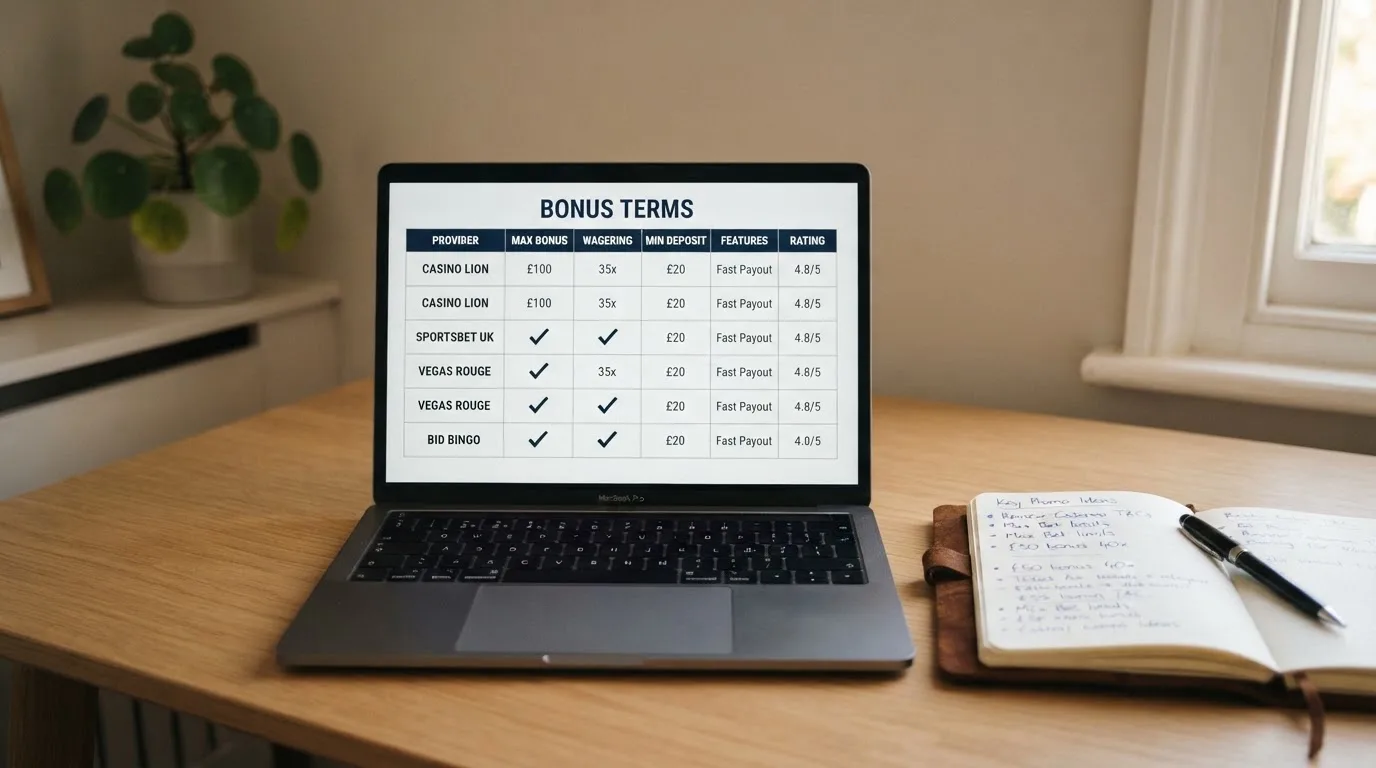
Three numbers anchor the picture. First, 139 businesses held an active remote casino operating licence on the Gambling Commission’s register on 18 September 2026 — considerably more than the ten featured here, with the remainder ranging from casino-only operators to large multi-vertical groups. Second, the same register recorded 1,065 active domain entries and 361 white-label entries on the same date. The white-label category is the one that sits beneath the radar: a domain trading on another licence, marketing under its own name, with the underlying compliance handled elsewhere. Third, the wagering cap that took effect in late 2025 governs what the bonus can ask the player to wager. None of these three numbers is set by any individual operator; each is fixed by statute, by the Commission’s case law or by the regulator’s published list.
The bonus product a UK player reads about looks small and friendly on the page: ten to twenty spins, no deposit required, log in and the day’s play runs on its own. The mechanical picture is the same animal as any other casino bonus, scaled down. Spins return winnings as bonus funds; those funds carry the 10x wagering requirement; the math behind the marketing word “free” is the same as it would be on a one-time welcome offer at ten times the size. Different scale, same mechanism. Marketing language softens it without changing what it costs.
The licence structure around the offer does three jobs. It enforces the 10x cap across every licensed operator — no brand can compete by raising the multiplier. It pulls in the GAMSTOP self-exclusion cross-check, the £150 financial vulnerability prompt, the deposit-limit pre-prompt and the identity verification — none of which are optional for the player, and none of which exist on an unlicensed platform. It also enforces the credit-card ban, the auto-play ban, the 2.5-second minimum spin duration, the £5/£2 stake cap (depending on age), and the prohibition on mixed-product bonuses. A reader in Great Britain choosing a licensed brand over an offshore one is buying this entire layer, not just the offer.
The catalogue of operators covered here is shaped by what the Commission’s register verifies, not by what each casino advertises. Every name on the list has a current licence, an active domain, an account number and a remote licence number on the public register. Every one of them runs the same 10x cap, the same GAMSTOP setup, the same identity-verification floor. What differs between them is parent structure (LC International runs three on the list; Rank Interactive, BV Gaming, WHG, Petfre, Platinum Gaming, Dribble Media and Tek Fox each run one), account age (some licences were issued in the early 2010s, others in the 2020s), and product emphasis (casino-first versus sportsbook-first, single-purpose versus multi-vertical). The daily-spins product itself — which one of these ten runs it, on what terms — is not on the register. That information sits with each operator’s published bonus terms.
The honest gap, however, is not the central finding. The central finding is that the reader’s decision is narrower than the marketing makes it look. The two binary choices — whether to play, and which UKGC-licensed brand to use — sit beneath a uniform regulatory floor the reader cannot negotiate. Inside that floor, what differs is product depth (catalogue size, game variety, table limits, live casino versus slots), bonus cadence (which title cycles through, when, and how often), and parent structure (which sets the support and complaints infrastructure on the back end). Each operator delivers all three in different proportions.
What a reader’s comparison is really doing, then, is ranking those proportions rather than the offers. Pick the brand whose product catalogue suits the day’s play. Pick the licence account whose compliance structure the reader most wants to be inside (which matters mostly for complaints handling). Read the bonus terms before each login, because the headline number on the offer is not the figure that determines what any winnings cash out at. That is the honest picture of the licensed daily-spins market on this register.
Common questions on UK daily free spins
How do daily free spins with no deposit actually work at a UK casino?
Once you log in, a UK casino credits a small number of slot spins to your account with no money changing hands. Winnings return as bonus funds and carry a wagering requirement. The 10x cap from 19 December 2025 limits that requirement to ten times the day’s bonus value before any withdrawal is permitted.
Do daily free spins come with wagering requirements at UK casinos?
Yes — every licensed casino bonus carries one since the 19 December 2025 cap. That requirement is bounded at ten times the bonus value, so a £5 daily bonus means £50 of qualifying wagers before withdrawal is permitted, and a £1 bonus means £10. Spins convert winnings into bonus funds before the multiplier applies.
Are daily free spins offers only for new players?
No. Daily login-credit spins are a recurring offer aimed at existing customers, distinct from a welcome bonus for new sign-ups. They run indefinitely for accounts in good standing, under the same 10x cap as any other UKGC bonus. Some operators split the credit across weekday and weekend cycles, but eligibility is unchanged.
Is there a cap on winnings from daily free spins?
Sometimes, but the 10x Gambling Commission cap governs the wagering rather than the payout ceiling. Operators can still apply their own maximum-cashout limits on bonus balances earned through daily free spins, and that figure sits in each casino’s published bonus terms. The cap varies across the ten operators listed.
Does a casino need a Gambling Commission licence to offer daily free spins in the UK?
Yes. The Gambling (Licensing and Advertising) Act 2014 requires any operator taking customers in Great Britain to hold a Gambling Commission licence, and the public register is the test of whether a brand holds one. Section 33 of the Gambling Act 2005 makes offering unlicensed gambling to GB residents an offence.