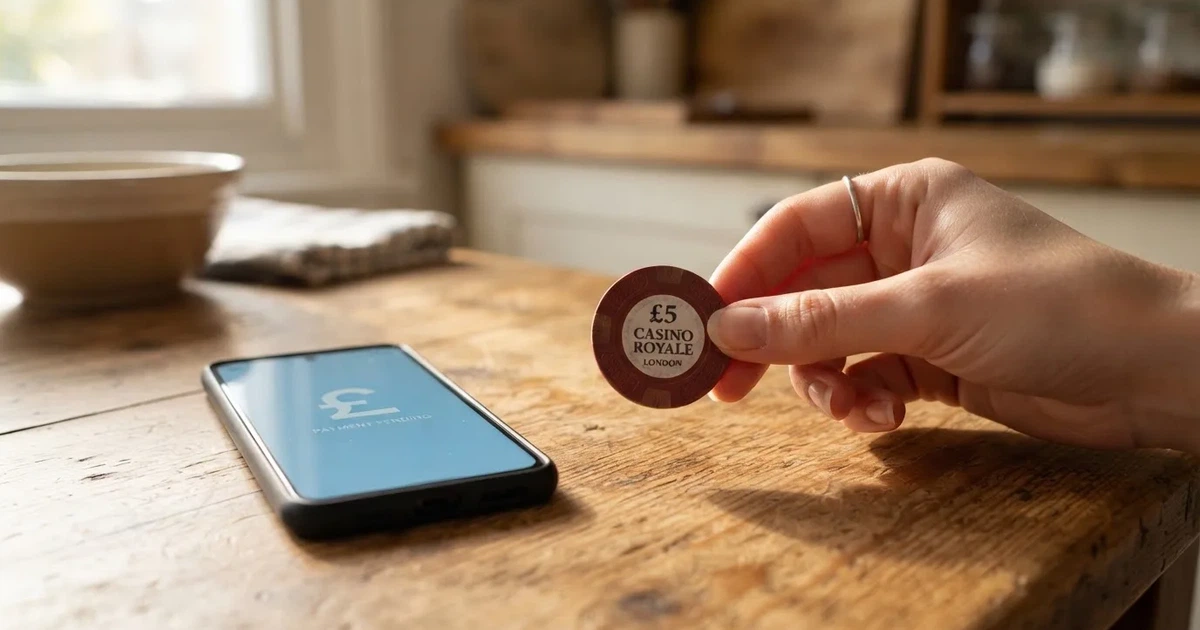
What a £2 minimum deposit gets you at a UK-licensed casino
 Available in GB
A small deposit removes a barrier most players name first: the moment when they realise a site wants £10 or £20 before they have decided whether to play there at all. At a properly licensed UK casino, £2 is enough to register, verify and try the lobby with real money on the line, with a GAMSTOP self-exclusion check and an age check still enforced. That distinction is the heart of this guide. A £2 minimum tells you the site is competing for cautious players; a Gambling Commission licence tells you what kind of operator is competing.
Current as of 23 September 2026, checked against the Gambling Commission’s public register.
Table of Contents
- How UK regulation shapes a £2 minimum deposit casino
- Responsible gambling tools at a £2 deposit site
- Paying £2 in and getting winnings out
- Ten UK-licensed casinos that accept a £2 minimum deposit
- How a 10x wagering cap changes the cost of a bonus
- Choosing between the licensed brands
- Things that look like a £2 deposit casino and are not
- What the £2 minimum actually changes
- Frequently asked questions about £2 minimum deposit casinos in the UK
How UK regulation shapes a £2 minimum deposit casino
Every operator taking deposits from players in Great Britain needs a remote operating licence from the Gambling Commission, the regulator set up under the Gambling Act 2005. The threshold at the cashier does not change that rule. A site advertising a £2 minimum without a current licence number on the register is operating outside UK law, and the deposit amount is not the only thing you lose in that case — you also lose access to GAMSTOP, the Commission’s complaints route and the approved alternative dispute resolution providers.

The Gambling Commission register is where the question gets answered
The Commission’s public register of gambling businesses is the definitive source. As of 18 September 2026 it listed 139 businesses holding an active remote casino operating licence, with the full data available to search online or download as CSV or Excel. A second table on the same register maps each licensed domain to its licence account and labels it Active, Inactive or White Label — on the same date that list held 1065 active and 361 white-label entries. A white-label site trades under another company’s licence, so two different brands can sit behind one licence number; the register makes the connection visible.
Remote licence numbers follow a fixed format — account-R-number-suffix — where the leading six digits repeat the licence holder’s account number and the “R” marks the licence as remote. Reading the licence back from the register is the only reliable way to confirm a brand’s status, because the brand’s own marketing rarely volunteers the details that matter most.
What verification looks like before that £2 lands
Since 7 May 2019 every UK-licensed operator must verify a customer’s name, address and date of birth before accepting the first deposit or allowing any play. A £2 minimum does not buy anonymity. The check is automated in most cases, drawing on credit-reference data and public records, and a player whose details fail to match is asked to upload documents. On a licensed site the £2 deposit that follows sits inside a verified account, not alongside a tolerated gap.
Responsible gambling tools at a £2 deposit site
Low entry points are sometimes marketed as a softer way to gamble, which is the wrong way to frame them. The same player-protection rules apply regardless of whether the first deposit is £2 or £200, and the rules in question are stricter than they were five years ago.
GAMSTOP and mandatory self-exclusion
GAMSTOP is the UK’s national online self-exclusion scheme. Every online licence issued by the Commission has included GAMSTOP participation as a condition since 31 March 2020. Players register with GAMSTOP directly, choose a period of six months, one year or five years, and the exclusion cannot be revoked early. Every UK-licensed casino must check the GAMSTOP database before letting a self-excluded player open an account or place a bet.

A brand that advertises “not on GAMSTOP” is, by definition, not licensed in Great Britain. That is not a value judgement — the operator may have a Curaçao or Maltese licence and offer perfectly ordinary games — but it is a precise description of the regulatory position. The Commission’s disruption powers are aimed at illegal sites: cease-and-desist notices, search-engine delisting requests, payment and hosting referrals. The Commission has no power to block sites at ISP level, which is why some unlicensed brands remain reachable from a UK IP address. The penalty for using one falls on the player, not on the operator: no GAMSTOP, no Commission complaints route, no approved ADR, and any self-exclusion the player has set becomes irrelevant.
Deposit limits, stake caps and other ground rules
Operators are required to prompt a customer to set a financial vulnerability limit before the first deposit, a rule in force from 31 October 2025. There is no fixed statutory deposit ceiling. A light-touch financial vulnerability check runs once a player reaches £150 in net deposits over a rolling 30 days — that figure took effect from 28 February 2025 and uses publicly available data only. Broader financial risk assessments have been signalled but are not yet in force.
Online slots carry a maximum stake per game cycle based on age: £5 for players 25 and over, from 9 April 2025, and £2 for players aged 18-24, from 21 May 2025. A “game cycle” begins when a player presses spin and ends when the result is displayed. That stake limit is a feature of the product, not of the deposit method, so even at a £2 minimum deposit site the bet you can place on a single slot spin is capped at the age-appropriate figure. Auto-play has been banned since 31 October 2021, individual spins must take at least 2.5 seconds, and “losses disguised as wins” — sound effects and congratulatory messaging on a spin that cost more than it paid out — are prohibited.
Paying £2 in and getting winnings out
The deposit is the easy half. Withdrawal is where the experience of a £2 minimum deposit casino diverges most sharply from how the marketing reads, and where the choice of payment method does almost all the work.
Deposit methods that actually accept £2
Debit cards and bank transfers are unaffected by the credit card ban that has been in place for UK gambling since 14 April 2020, which is why these two channels dominate the cashier at most UK-licensed sites. Both can clear small deposits quickly. Bank transfers in the UK typically run through the Faster Payments Service, operated by Pay.UK and live since 2008, which processes payments 24 hours a day, seven days a week; most arrive instantly or within a couple of minutes, and the scheme sets a £1,000,000 per-transaction limit (individual banks can set their own lower caps).
Apple Pay is available at some UK-licensed casinos but is governed by its own conditions: a supported card from a participating issuer, the right device, and UK card support that has been available since 14 July 2015. Apple Pay uses tokenisation — the card number is replaced by a device-specific token — and a dynamic security code per transaction, which is why the deposit still lands on the player’s bank statement as a card transaction. AstroPay, founded in 2009 and headquartered in Uruguay, is another e-wallet option at some sites. Its UK entity, Larstal Limited, is authorised by the Financial Conduct Authority under the Electronic Money Regulations 2011, which puts it on a different regulatory footing from a casino licence but covers the money side of the transaction.
Why credit cards are no longer part of this picture
The Commission’s research found that around 800,000 UK consumers used credit cards to gamble in 2018, and that 22% of online gamblers who funded play with credit cards were classed as problem gamblers. The ban that followed, in force since 14 April 2020, applied across all online and offline gambling products in Great Britain except non-remote lotteries paid for in person, and it also covers credit card funding routed through e-wallets. A player who tries to deposit with a credit card at a UK-licensed casino today will simply be declined.
Withdrawal speed and what affects it
The Faster Payments infrastructure that handles many deposits also handles a substantial share of withdrawals. The cap of £1,000,000 per transaction rarely matters at this end of the market, where a £2 deposit is unlikely to have produced a withdrawal that large. Most withdrawals via Faster Payments settle within minutes or a few hours, though the casino’s own internal processing time is usually the bottleneck — a licensed site must verify the withdrawal request against the verified account before releasing funds, and many operators quote 24-72 hours of internal processing on top of the bank transfer time. E-wallets can be faster at the cashier end but usually still require the casino’s internal approval before the funds leave the operator’s account.
The deposit size does not influence the withdrawal speed. A site that takes a day to process a £2 withdrawal does not take longer for a £200 withdrawal, and a site that processes withdrawals in hours will not slow down for the smaller amount. The cost is identical at both ends; only the internal review trigger matters.
Ten UK-licensed casinos that accept a £2 minimum deposit
The list below draws every brand from the Gambling Commission’s public register of gambling businesses, as it stood on 18 September 2026. Each entry shows the licence account, the licensee, the licence number and the account’s listed domain status. None of these brands is recommended over another here; the table exists so a reader can verify status quickly and see which operator each licence belongs to. Several brands can share one licensee — Ladbrokes, Coral and Gala Bingo all sit under LC International Limited — and a white-label site trades under another company’s licence, so brand independence and licence independence are different questions.
| Brand | Licence holder and GB remote casino licence | Domain status on the register | Subject support |
|---|---|---|---|
| PokerStars | Stars Interactive Limited (account 39108), 039108-R-319334-026 | Active | — |
| Betfred | Petfre (Gibraltar) Limited (account 39544), 039544-R-319290-010 | Active | — |
| Betfair | PPB Games Limited (account 39411), 039411-R-319335-010 | Active | — |
| bet365 | Hillside (UK Gaming) ENC (account 55149), 055149-R-331499-004 | Active | — |
| Unibet | Platinum Gaming Limited (account 45322), 045322-R-324275-019 | Active | — |
| Coral | LC International Limited (account 54743), 054743-R-330863-014 | Active | — |
| Casumo | Recro Limited (account 61549), 061549-R-336718-002 | Active | — |
| 888casino | 888 UK Limited (account 39028), 039028-R-319297-014 | Active | — |
| kwiff | Eaton Gate Gaming Limited (account 44448), 044448-R-323408-017 | Active | — |
| Midnite | Dribble Media Limited (account 42647), 042647-R-321653-022 | Active | — |
The register’s domain count — 1065 active and 361 white-label entries on the same date — tells you the table above is the thin edge of a much wider licensed market. The brands featured here were selected for the breadth of their UK presence, not for any advantage in the £2 deposit tier; a site a player has never heard of can hold an identical licence.
What the table tells you that the marketing does not
Two things stand out. First, every licence number begins with the six-digit account number, which means a reader who checks the register can confirm the match without a magnifying glass. Second, several licensees use the same parent group: LC International Limited covers Coral; Petfre (Gibraltar) Limited is the Betfred parent. Where brands share a licensee, complaints, dispute resolution and self-exclusion mechanics are likely to look similar — there is one operator behind the front door.
A “white-label” entry on the domain list is one that trades under another company’s licence. The register surfaces this explicitly because the operator doing the marketing is not the operator holding the licence, and a player with a complaint needs to know which entity is on the other end. For the brands above the register marks each domain as Active, meaning the licence is in force and the domain is being used to take customers.
How a 10x wagering cap changes the cost of a bonus
A £2 minimum deposit is not, on its own, a promotional offer — it is a cashier setting. The bonuses attached to a deposit that small are usually modest, and the rules that govern how those bonuses are cleared matter more than the headline figure. Since 19 December 2025 the Gambling Commission has capped wagering requirements at 10x, which means the turnover required to release a bonus is no more than ten times the bonus value. Mixed-product bonuses — an offer that gives casino spins in return for placing a sports bet — are banned under the same rule set.
A player who takes a £10 bonus at a UK-licensed site now knows the upper bound of what they must wager to clear it: £100 of qualifying turnover, and no more. At an offshore site the same offer might carry a 35x or 50x multiple, so the same £10 bonus becomes £350 or £500 of turnover before withdrawal. The 10x cap is the reason this number has stopped being a meaningful differentiator between licensed UK brands — they all sit beneath it.
A worked example at the £2 minimum
A £2 deposit that triggers a £2 bonus (one-for-one match) carries a wagering requirement of up to £20, since 10×2 = 20. At a slot spin price of, say, 10p, that is 200 spins. A licensed UK slot cannot complete a spin in less than 2.5 seconds; 200 spins therefore takes at least 500 seconds, or just over eight minutes. The arithmetic is the same whichever licensed site the player uses — the cap binds. What changes is the return: a 96% return-to-player slot over 200 spins returns £19.20 of the £20 wagered on average, leaving an expected loss of around 80p on the bonus playthrough alone, before the underlying £2 deposit is taken into account. A higher-volatility slot widens that range; a lower-volatility slot narrows it. None of these figures is a guarantee for any single session.
The lesson is that the bonus’s apparent value — “free money” — is the wrong frame. The actual cost is the turnover the bonus requires multiplied by the house edge on the games used to clear it, and at a 10x cap that cost is small. The framing matters because it is the same arithmetic at every licensed UK casino, and the arithmetic is what a player needs in order to compare one offer against another.
Choosing between the licensed brands
The licensed set is wider than any article can feature, and the table above picks ten names that readers will recognise. That selection does not by itself make any of them a better place to play. The differences between licensed UK casinos that accept a £2 minimum are smaller than the marketing implies, because most of the meaningful protections — GAMSTOP, age verification, the 10x wagering cap, the credit card ban, the financial vulnerability check — are identical at every brand.
What separates one licensed site from another
A few dimensions still vary:
- Game library and software providers. The providers a casino signs with determine which slots and table games appear in the lobby; bet365 and PokerStars lean on a stable of established studios, while Casumo and 888casino have built their identity around wider catalogues.
- Withdrawal processing speed. Faster Payments makes the bank-side of the transfer near-instantaneous, but the casino’s internal review is the rate-limiting step, and operators quote different windows. A site that pays out within hours is materially different from one that holds withdrawals for three days.
- Live-dealer and sportsbook cross-product play. Coral, Betfair and bet365 integrate casino with sports betting under one account; PokerStars, 888casino and Casumo are casino-first. The integration matters only if a player wants to use one account across products.
- Mobile experience. Each brand above offers a mobile app or a mobile-optimised site, but the depth of those apps varies. A player who intends to play mostly on a phone has a separate decision to make.
What does not vary
The deposit limit a player can set, the GAMSTOP check at sign-up, the age verification, the credit card decline, the wagering cap, the financial vulnerability prompt — all of these are uniform across the licensed set. The Commission does not let an operator pick and choose among the player-protection rules. A reader comparing one brand against another is comparing product, not regulation.
Things that look like a £2 deposit casino and are not
Two patterns recur around these terms and are worth naming clearly. A reader who lands on either one has, in practical terms, left the UK licensed market.
“Not on GAMSTOP” sites
A casino that advertises itself as “not on GAMSTOP” is signalling that it does not hold a Gambling Commission licence. Some of these sites hold licences in other jurisdictions — Curaçao, Malta, the Isle of Man, occasionally Kahnawake — and many of them are run by competent operators. What they cannot offer is the package of protections the Commission requires: GAMSTOP participation, the Commission’s complaints route, ADR access, and the financial vulnerability checks. A player who has registered with GAMSTOP can still open an account at such a site, because the GAMSTOP database is not consulted. That is sometimes framed as a feature and is sometimes framed as a flaw; it is, more usefully, a description of the regulatory position.
Offshore brands holding other licences
A Maltese Gaming Authority licence permits a site to operate across the EU and the UK under transitional arrangements; a Curaçao licence permits operation across most of the rest of the world. Neither licence carries the Commission’s 10x wagering cap, the credit card ban or the GAMSTOP requirement. The Commission’s response to unlicensed sites targeting UK customers has been to issue cease-and-desist notices, request search-engine delisting, and refer hosting and payment providers, but it cannot order ISPs to block sites in the way some other regulators can. A UK player who chooses an offshore brand gives up the protections without any compensating gain in the deposit tier — most licensed UK sites also accept £2 deposits, so the “offshore” route is not a workaround for a high minimum.
What the £2 minimum actually changes
At the cashier, £2 removes a barrier. At the lobby, it removes almost nothing: every slot bet is still subject to the age-based stake cap, every spin still takes at least 2.5 seconds, every bonus still carries its wagering requirement. The deposit size has not freed the player from the rules; it has let them in under them.
The honest read is that the £2 minimum deposit casino UK is, in regulatory terms, the same product as the £20 minimum deposit casino UK. Both sites run under the same licence, the same GAMSTOP check, the same 10x wagering cap, the same withdrawal mechanics. The £2 entry point exists because the operator wants to convert hesitant sign-ups, and a UK player who treats it as a low-cost trial — a way to see how a particular site handles verification, withdrawal and bonus terms — is using the threshold the way it was meant to be used.
Frequently asked questions about £2 minimum deposit casinos in the UK
What counts as a £2 minimum deposit at a licensed UK casino?
A £2 minimum means the cashier will accept a deposit of £2.00 or more, processed through a permitted payment method — debit card, bank transfer, or certain e-wallets. Credit cards have been banned for UK gambling since 14 April 2020, and even when a credit card sits inside an e-wallet it cannot be used to fund a gambling account.
Is a £2 minimum deposit casino safe to use?
It is safe in the sense that a UK-licensed casino is regulated: name, address and date of birth must be verified before play, GAMSTOP is checked, the 10x wagering cap and credit card ban apply, and complaints route through the Commission and an approved ADR. A casino advertising a £2 minimum without a current UKGC licence is operating outside the regulated market, and “safe” no longer applies.
Can I find a £2 minimum deposit casino that isn’t on GAMSTOP?
Yes — but only by leaving the UK licensed market. The Commission’s licence conditions require GAMSTOP participation, so any site without GAMSTOP integration is either unlicensed in Great Britain or licensed elsewhere. A player who has self-excluded through GAMSTOP will not be stopped at such a site, which is precisely the regulatory gap the scheme is designed to close.
How quickly do withdrawals settle after a £2 deposit?
The withdrawal speed does not depend on the deposit amount. UK bank transfers run through the Faster Payments Service, where most payments arrive within minutes or a couple of hours, with a scheme limit of £1,000,000 per transaction. The bottleneck is the casino’s internal processing — typically 24 to 72 hours — during which the operator verifies the request against the verified account.
Which payment methods accept a £2 minimum deposit?
Debit cards and bank transfers are the most reliable at this minimum. Some e-wallets, including Apple Pay (where the underlying card is a debit card from a participating issuer) and AstroPay (through its FCA-authorised UK entity Larstal Limited) will also accept small deposits. Credit cards are excluded across all UK-licensed operators, regardless of whether they are presented directly or through a wallet.
Prepared by the onlinebingoguideuk editorial staff.