
Three-Reel Slots at UK-Licensed Sites: What 2026 Actually Offers
 Available in GB
The classic three-reel slot is the grandparent of every modern video slot, and the format has refused to retire. Simple paylines, a small set of symbols, the clatter of a stopped reel — these are what a player after a back-to-basins experience is looking for. In the UK that format now sits inside one of the most heavily regulated gambling markets in the world, which is where this page starts.
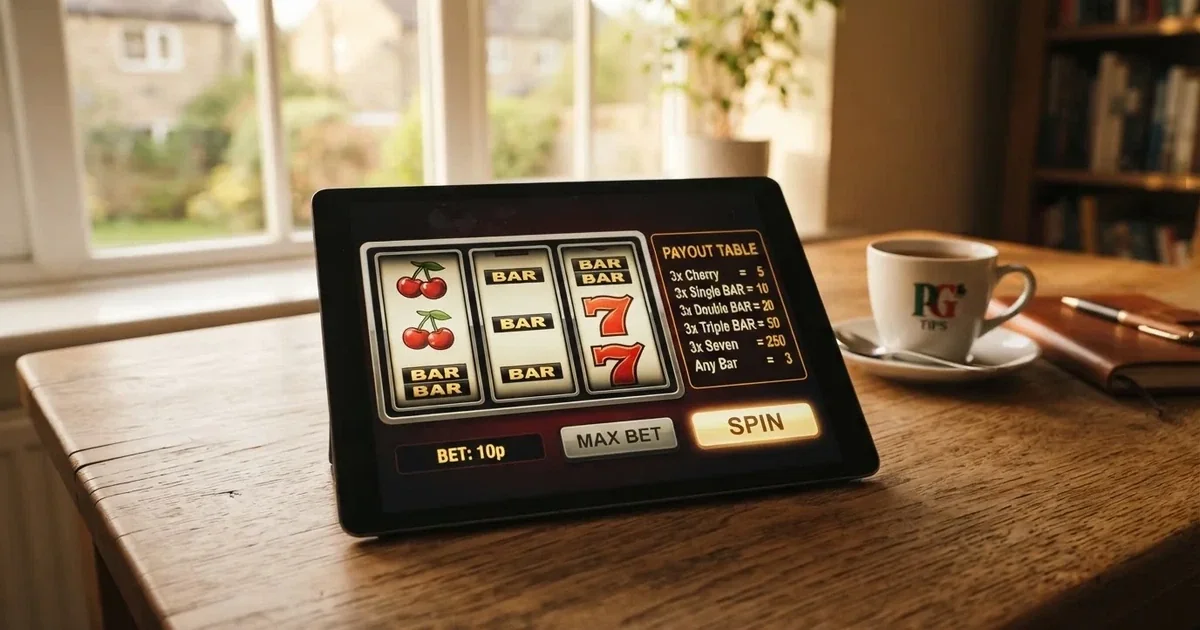
The piece works through the licence frame that lets a UK player spin at all, the rules that govern how those spins happen, the cost mechanics of a bonus when one is on offer, and a side-by-side look at ten Gambling Commission licensees that run three-reel games alongside their wider catalogues. The arithmetic on a bonus cap, the no-registration demo question, and the difference between a three-reel and a five-reel game are all covered in the section that owns them.
The data in this article is current as of 23 September 2026, checked against the Gambling Commission’s public register of gambling businesses.
Table of Contents
- The Licences That Let a UK Player Spin in the First Place
- Responsible Play: GAMSTOP, Stake Caps and the Three Rings Around a Spin
- Crypto, Anonymity and the Question of No-Registration Play
- Payments, Payouts and the Cost of a Spin
- The Three-Reel Format: Paytables, Volatility and Why the Format Endures
- Side-by-Side: Ten GB-Licensed Operators That Run Three-Reel Slots
- Reading the Format in 2026: What the Rules Have Changed
- Where the £10 Wagering Cap Lands on a Real Bonus
- The Wider UK Online Gambling Market in 2026
- Frequently Asked Questions About Three-Reel Slots in the UK
The Licences That Let a UK Player Spin in the First Place
A site offering real-money three-reel slots to players in Great Britain needs a remote casino operating licence issued by the Gambling Commission under the Gambling Act 2005. The Commission is sponsored by the Department for Culture, Media and Sport, and the Act covers England, Scotland and Wales rather than Northern Ireland. Since the Gambling (Licensing and Advertising) Act 2014 any operator taking UK customers must hold a Commission licence regardless of where it is incorporated, so a Malta or Curaçao registration alone does not suffice.

The Commission’s public register is the only test that counts. On 18 September 2026 it listed 139 businesses holding an active remote casino operating licence, each searchable and downloadable in CSV or Excel form for anyone who wants to verify a brand themselves. Every licence number on the register follows the same shape — six-digit account number, an “R” marker for remote, a sequence number, and a suffix — which makes a check mechanical. Paddy Power’s licence reads 039411-R-319335-010; the leading six digits, 039411, repeat the licence holder’s PPB Games Limited account.
The same register also tracks domains. Each licence account carries a list of websites run under it, with a status flag of Active, Inactive or White Label. White Label is the legal shape brands like Virgin Games take: the domain trades under another company’s licence rather than holding its own. On 18 September 2026 the register held 1065 active and 361 white-label domain entries — the active count is the live surface, the white-label count is how the same licence is reused to dress multiple brands.
The Commission has no power to block ISPs, so unlicensed offshore sites continue to be reachable from a UK connection. Section 33 of the Gambling Act 2005 makes it an offence to provide gambling to people in Great Britain without a Commission licence, and the regulator disrupts those sites by issuing cease-and-desist notices, requesting search-engine delisting, and referring payment and hosting providers. The penalty does not fall on the player — what they lose on an unlicensed site is the protection layer. No GAMSTOP, no Commission complaints route, no approved alternative dispute resolution. That gap is the price of playing outside the registered set, even when the marketing looks identical.
Responsible Play: GAMSTOP, Stake Caps and the Three Rings Around a Spin
Three layers of consumer protection apply to every spin of a licensed three-reel slot in the UK, and they are worth naming in the order they bite.

Self-exclusion through GAMSTOP is mandatory for every online licence. GAMSTOP is the national online self-exclusion scheme, and joining it bars a player from every GB-licensed operator in a single step. Exclusion periods run six months, one year or five years, and cannot be cancelled early. A player completing the sign-up is locked out across the registered set rather than only at the brand where they first registered, which is the feature’s point.
Stake and spin-speed rules govern how the games themselves run. Online slots carry a maximum stake per game cycle — £5 for players aged 25 and over, in force from 9 April 2025, and £2 for 18 to 24 year olds, in force from 21 May 2025. The £2 figure is set against the data that 18 to 24 year olds record the highest average problem gambling score of any age group, lower disposable income and ongoing neurological development cited together as the rationale. A slot spin may not complete faster than 2.5 seconds, and auto-play is permanently banned — both measures date from the Commission’s 2021 safer-by-design package. Losses disguised as wins, the small payout that plays a win-tune, are banned under the same rules.
Deposit limits and vulnerability checks shape the money side. Operators must prompt a customer to set a financial limit before the first deposit; the prompt has been mandatory since 31 October 2025. There is no state-set deposit or loss ceiling beyond what the customer chooses, but financial vulnerability checks fire automatically once a player hits £150 in net deposits over a rolling 30 days, in force from 28 February 2025 — that figure uses public data only, with the wider risk-assessed checks announced but not yet in force. The minimum age is 18, and name, address and date of birth must be verified before the first deposit or any play, a regime in force since 7 May 2019. Reverse withdrawals, the option to send money back into a casino balance after requesting a payout, were banned for UK operators by 31 October 2021.
Help sits outside the licence frame but inside the same route. The National Gambling Helpline runs through GamCare, and GambleAware funds treatment and research across Great Britain. A self-excluded player cannot undo GAMSTOP through customer service; the lock-out is the lock-out.
Crypto, Anonymity and the Question of No-Registration Play
Three-reel slots are unusually well suited to the no-registration demo path, and a player who wants to try a few spins without signing up can do so at most providers’ sites, where the reels run on demo credits. The reels spin, the paylines resolve, the player sees what a bonus feature does — all without an account, an email or a payment instrument on file. That is the practical reading of the search phrases that turn up around this topic: free three-reel slots no registration, no download, no deposit.
The same cannot be said of real-money play at a UK-licensed site. A Gambling Commission licensee must verify a customer’s name, address and date of birth before the first deposit or any real-money spin, and that is a hard condition rather than a feature the operator can switch off. Anonymous play is not possible at a licensed site. The credit-card ban, in force since 14 April 2020, removes one more payment route — credit cards are out for gambling, including when an e-wallet is used to route a credit balance to a casino. The wagering cap and the mixed-product bonus ban, both in force from 19 December 2025, push back against the bonus structures that previously pulled crypto-style offshore brands into a UK-shaped marketing proposition.
What this leaves is a clean split. A player who wants the format without the friction can play demos freely, often with no download. A player who wants real money on the result runs through full verification at a GB-licensed site, and that site must sit inside the GAMSTOP perimeter. The two paths are separate and they are different products, not different intensities of the same thing.
Payments, Payouts and the Cost of a Spin
Three-reel slots themselves do not have their own payment rails. A deposit funds a casino account, and that balance funds every spin across every game the licensee offers. Where the format matters is in the cost mechanics, which is what most searches around payout, best-paying and high-payout three-reel slots are actually asking.
Deposits and the no-deposit demo. No-deposit demos at a provider’s own site run on credits the player cannot cash out; no-deposit bonuses at a licensed casino, where they exist, are governed by the 10x wagering cap. From the player’s side, the test is whether the bonus structure is permitted at all under the rules in force, and whether the wagering requirement is stated as a multiple of the bonus or the bonus-plus-deposit.
Payouts. Three-reel games in the UK fall under the same payout framework as every other online slot: winnings are added to the casino balance, the player requests a withdrawal, and reverse withdrawals have been banned since 31 October 2021. The Commission’s stake and spin-speed rules apply regardless of game format — a £5 or £2 ceiling, a 2.5-second minimum spin — so a high-volatility three-reel title cannot be spun faster to chase a hit. Return-to-player figures for individual games are set by the operator and tested by the Commission, and the rules require operators to monitor live RTP performance, compare actual returns against the advertised figure, and raise alerts when the gap exceeds an acceptable range; a confirmed error triggers a key-event report and feeds into the annual games-testing audit.
The bonus cap arithmetic. The 10x wagering limit introduced on 19 December 2025 significantly changed the structure of bonus offers at GB-licensed operators. A £100 bonus now requires £1,000 of qualifying turnover before withdrawal, replacing the 30x or 40x requirements that were common previously. At a £1 stake and a five-second average spin, that £1,000 turnover translates to around 1 hour 23 minutes of play at the lower stake ceiling. The result is a more manageable session length compared to the all-evening grind of older bonus structures.
The cap also blocks mixed-product bonuses, so a sportsbook offer that used to throw in casino spins alongside a free bet is no longer a route to a three-reel bonus. Anonymous play is excluded at a licensed site; the cap sits inside the licensed frame.
The Three-Reel Format: Paytables, Volatility and Why the Format Endures
The three-reel slot is the slot machine. Charles Fey of San Francisco built the first automatic slot machine in the 1890s — the Liberty Bell — with three reels bearing horseshoes, diamonds, spades, hearts and the bell symbol that gave the machine its name. Three aligned bells paid ten nickels, or 50 cents, the top prize in an era when a nickel was a working wage. Sittman and Pitt of Brooklyn had produced a poker-based drum machine in 1893 with five reels and 50 card faces, though it made no automatic payouts. Herbert Mills produced the first copy of the Liberty Bell in 1907.
Modern three-reel slots look almost nothing like Fey’s brass-and-iron original, but they share two structural features. The reels count is fixed at three, and the symbol set is small — typically a handful of high-paying symbols, a smaller handful of low-paying ones, and one or two special symbols such as wilds or bonus triggers. The paytable is correspondingly short: one row per symbol, sometimes a separate row for combinations of two, sometimes a row for the special symbol. A player can read the whole paytable in under a minute, which is part of the appeal.
Volatility, the term the wider slot literature uses, describes the shape of the payout curve: a low-volatility slot pays smaller wins more regularly, while a high-volatility slot pays fewer but larger wins. The format itself does not determine volatility — a three-reel game can be calibrated either way — but the format’s mechanics push most three-reel titles toward the middle of the range. Fewer reels means fewer symbol positions, which means fewer possible combinations, which means fewer payout tiers; the result is a game where the payout distribution is concentrated around a smaller set of outcomes and the variance is often lower than a five-reel video slot with dozens of paylines and a bonus feature. That is the trade-off a player is making when they pick a three-reel title over a five-reel one.
Inge Telnaes, a Norwegian mathematician, patented technology in 1984 for using a random number generator to select reel-stop positions, letting manufacturers weight symbol probabilities independently of how often each symbol physically appears on a reel. The result is that the visible reel is largely a presentation choice; the outcome is set by software. This is why two three-reel slots can look identical on the reels and run very different payout curves underneath, and why the operator-set theoretical return-to-player figure is the headline number rather than the symbol layout. Jurisdictions set different minimums — Nevada at 75%, New Jersey at 83%, the UK under the Gambling Act 2005 with no statutory floor but with a tested RTP requirement monitored live.
Side-by-Side: Ten GB-Licensed Operators That Run Three-Reel Slots
The brand-by-brand comparison below sets out the ten operators routed into this ranking. Every brand sits on the Gambling Commission’s public register as a remote casino licensee, and every brand is therefore inside the GAMSTOP perimeter and subject to the stake, spin-speed and bonus-cap rules described earlier. The licence number, account number, licence-holder name and domain status are taken from the Commission’s register snapshot of 18 September 2026. The “subject support” column reflects what the register itself records about whether the brand carries the games this page covers; for all ten, the Commission’s domain list does not specifically catalogue the three-reel range, so that column carries the no-data marker for every row. The reader looking for a specific three-reel title should verify the catalogue on the operator’s own site before signing up.
| Brand | Licence holder and GB remote casino licence | Domain status on the register | Subject support |
|---|---|---|---|
| Paddy Power | PPB Games Limited · 039411-R-319335-010 | Active (account 39411) | — |
| Unibet | Platinum Gaming Limited · 045322-R-324275-019 | Active (account 45322) | — |
| Sky Vegas | Bonne Terre Gaming Limited · 065519-R-339675-002 | Active (account 65519) | — |
| kwiff | Eaton Gate Gaming Limited · 044448-R-323408-017 | Active (account 44448) | — |
| bet365 | Hillside (UK Gaming) ENC · 055149-R-331499-004 | Active (account 55149) | — |
| MrQ | Tek Fox Ltd · 060629-R-337532-004 | Active (account 60629) | — |
| Midnite | Dribble Media Limited · 042647-R-321653-022 | Active (account 42647) | — |
| Virgin Games | Gamesys Operations Limited · 038905-R-319430-022 | White Label (account 38905) | — |
| BetVictor | BV Gaming Limited · 039576-R-319370-028 | Active (account 39576) | — |
| Grosvenor Casinos | Rank Interactive (Gibraltar) Limited · 057924-R-334666-005 | Active (account 57924) | — |
The ten sites spread across two structural shapes. Nine of them are active licences in their own right — the licence holder and the brand are commercially aligned, even where the operating company is based offshore. The tenth, Virgin Games, is a white-label: the brand trades under Gamesys Operations Limited’s licence rather than holding its own, which means the brand’s compliance footprint is Gamesys’s rather than Virgin’s own. That detail matters when something goes wrong — the accountable party on the Commission’s books is Gamesys — and the register flags the structure explicitly.
The second observation is that several of these licences sit under the same small set of operating companies, which means brand-level variation on game catalogue is largely a marketing-layer choice rather than a platform-layer one. A reader comparing three-reel ranges across two of these brands is often comparing two front ends on the same games backend.
The third is that the licence frame is what the brands share, not what they compete on. Every one of them must verify identity before deposit, enforce GAMSTOP exclusions, prompt a financial limit before the first deposit, cap stakes at £5 or £2, run spins at no faster than 2.5 seconds, and comply with the 10x wagering limit effective from late 2025. Those constraints are constant across the registered set; the brand-level differences show up in catalogue breadth, payout speed, customer service and bonus structure within the cap.
Paddy Power
Paddy Power runs under PPB Games Limited, licence 039411-R-319335-010, with Paddy Power listed as an active domain on the Commission’s register. The wider Paddy Power group carries a substantial UK footprint across sportsbook and gaming, and the casino product sits inside that frame rather than as a standalone brand. Three-reel slots at Paddy Power are part of a larger catalogue that the operator has built out around more recent video slot formats; the brand’s strength in this space is depth rather than focus. The reader who already has a Paddy Power account and wants a quick three-reel session alongside their usual sportsbook activity is well served; the operator’s catalogue should be verified directly for specific three-reel titles before play commences.
Unibet
Unibet’s UK site runs under Platinum Gaming Limited, licence 045322-R-324275-019. The brand’s catalogue tends to lean toward a wider international mix, including the kind of smaller-studio releases that often include three-reel formats in their back catalogues. Platinum Gaming’s licence is active on the register, and unibet.co.uk is recorded as the active domain. The reader who values catalogue breadth over a familiar high-street brand will find Unibet’s range a useful counterweight to the bookmaker-led entries above.
Sky Vegas
Sky Vegas operates under Bonne Terre Gaming Limited, licence 065519-R-339675-002, with Sky Vegas on the register as an active domain. The Sky brand carries a TV-and-broadband parent in the background, and the casino product draws on the Sky membership as much as on the casino catalogue itself. The three-reel range sits inside a wider Sky Vegas library that is curated rather than maximalist. The casual player with an existing Sky account will likely find this the most frictionless entry point for adding casino games to their activity.
kwiff
kwiff runs under Eaton Gate Gaming Limited, licence 044448-R-323408-017. The brand’s marketing centres on a “surprise” mechanic around odds and stake boosts, and the casino product is a smaller part of the overall offer than at the bookmaker-led brands above. Three-reel coverage on kwiff is a more marginal proposition than at the larger casino-led brands, and the reader choosing kwiff specifically for the three-reel range should treat the casino as a complement to the sportsbook rather than as the main event.
bet365
bet365 runs under Hillside (UK Gaming) ENC, licence 055149-R-331499-004, with Bet365.com on the register as an active domain. bet365 is one of the larger UK-licensed operators and the casino product carries a substantial catalogue of slots, table games and live-dealer formats. The three-reel range sits inside a casino product that is built for volume rather than focus. The reader who wants a single account that covers sports, casino and the three-reel format together is the natural fit here.
MrQ
MrQ runs under Tek Fox Ltd, licence 060629-R-337532-004, with Mrq.com listed as an active domain. MrQ positions itself around no-wagering bonuses, which sits cleanly inside the 10x cap that took effect on 19 December 2025; a no-wagering offer has a multiplier of 0x and therefore stays well inside the ceiling. The casino catalogue carries a smaller number of titles than the larger brands, with a curated mix that includes classic formats. The reader who values a no-wagering offer and a focused catalogue is well matched to MrQ.
Midnite
Midnite runs under Dribble Media Limited, licence 042647-R-321653-022, with Midnite.com as the active domain. Midnite entered the UK market with a sportsbook-led proposition and built out a casino product around it. The three-reel range is a smaller part of the catalogue than at the casino-led brands above, and the operator’s strength is in the newer video slot formats. The platform’s existing sportsbook users will find the navigation and betting environment straightforward, though those focusing exclusively on three-reel titles should confirm the catalogue coverage.
Virgin Games
Virgin Games runs as a white-label brand under Gamesys Operations Limited, licence 038905-R-319430-022. The Virgin name carries consumer-brand recognition that the licence-holder name does not, but the licence sits on Gamesys’s books — meaning the accountable party on the Commission’s register is Gamesys, not Virgin. The Gamesys platform carries a deep catalogue that includes the three-reel formats, and the white-label structure means the catalogue is the same shape as at Gamesys’s other brands. The reader who values the Virgin name over an unfamiliar operating company should know that the compliance footprint is Gamesys’s rather than Virgin’s.
BetVictor
BetVictor runs under BV Gaming Limited, licence 039576-R-319370-028, with Betvictor.com as an active domain. BetVictor is one of the longer-established names in the UK market, and the casino product sits alongside a substantial sportsbook. The three-reel range is part of a wider catalogue that has been built over the operator’s long UK presence. The reader who values longevity and a familiar UK-facing brand over a newer international name will find BetVictor’s structure familiar.
Grosvenor Casinos
Grosvenor Casinos runs under Rank Interactive (Gibraltar) Limited, licence 057924-R-334666-005. Grosvenor’s distinctive feature among this set is the parent company’s land-based casino estate, which gives the online brand a different starting point than the digital-native operators above. The three-reel range sits inside an online catalogue that connects to the wider Grosvenor brand across retail and online. The reader who values the link to a physical casino estate alongside an online account is the natural fit here.
Reading the Format in 2026: What the Rules Have Changed
Three structural shifts since 2021 shape what a UK player meets when they sit down with a three-reel game in 2026. The first is the safer-by-design package — the 2.5-second minimum spin, the auto-play ban, the losses-disguised-as-wins ban and the reverse-withdrawal ban — all of which are mechanical changes to how a spin runs rather than to the game catalogue. A three-reel game cannot be sped up, cannot be set to autoplay, cannot dress a small payout as a win, and cannot let a player pull a withdrawal request back into the casino balance.
The second is the stake ceiling. £5 per spin for over-25s from April 2025, £2 per spin for 18 to 24 year olds from May 2025. The lower ceiling for the younger cohort is the explicit policy response to the data that 18 to 24 year olds carry the highest average problem gambling score, lower disposable income and ongoing neurological development — a single rule with three reasons behind it.
The third is the bonus framework. The 10x wagering cap from 19 December 2025 reshapes the cost curve of every promotion a GB-licensed operator runs, and the ban on mixed-product bonuses closes the sportsbook-to-casino routes that previously fed free-spin offers into slot play. A three-reel player chasing a bonus offer is now reading a much shorter and more legible set of terms than they were before.
The verification regime sits alongside all three. Name, address and date of birth must be confirmed before the first deposit or any play, in force since 7 May 2019. The credit-card ban, in force since 14 April 2020, removes that route. GAMSTOP, mandatory for every online licence since 31 March 2020, sits as a single sign-up that locks the registered set rather than one brand.
The arc of the past five years is toward a tighter, more legible framework: lower stake ceilings, slower spins, simpler bonus terms, universal verification. Three-reel slots — a format older than every other game in the modern UK casino — sit inside that frame without exemption.
Where the £10 Wagering Cap Lands on a Real Bonus
The 10x wagering rule, in place since 19 December 2025, restricts how much playthrough a bonus can require at a GB-licensed operator. The arithmetic belongs to the player, because the same cap lands very differently depending on the stake and the spin speed.
Take a £100 bonus at the standard 10x requirement. Required turnover is £1,000. At a £1 stake per spin, that is 1,000 spins; at the regulated minimum spin interval of 2.5 seconds, with five seconds a more realistic average including pauses and feature rounds, 1,000 spins work out at roughly 1 hour 23 minutes to 2 hours 20 minutes of play. At a £2 stake, the same £100 bonus needs 500 spins, which is around 42 minutes to 1 hour 10 minutes. At a £5 stake, 200 spins, which is around 17 minutes to 35 minutes — though the £5 ceiling only applies to over-25s, and any session beyond the £150 net-deposit mark in 30 days will trigger a financial vulnerability check.
The band is wide because the session length depends on what the player does between spins, but the order of magnitude is what changed. A £100 bonus is now an hour-or-two of gameplay rather than the all-evening grinds that 30x and 40x requirements produced. The same logic scales: a £50 bonus at 10x is £500 of turnover, around 500 spins at a £1 stake or 100 spins at a £5 stake; a £200 bonus at 10x is £2,000 of turnover, around 2,000 spins at £1 or 400 at £5. The 10x cap puts a ceiling on the time-cost of any bonus offer at a GB-licensed operator, which is the policy’s purpose.
What it does not do is make a bonus free. The wagering requirement clears the bonus for withdrawal, but the gameplay itself carries the operator-set house edge, and the time-cost of clearing a bonus is paid in spins at that edge. The 10x cap is a real improvement on the previous regime, and it is not a free lunch.
The Wider UK Online Gambling Market in 2026
The Commission’s public register is the headline number for the licensed side of the UK online market. 139 active remote casino operating licences on 18 September 2026, against a domain register that held 1065 active and 361 white-label entries the same day. Those are the counts of businesses and domains, not of customers or revenue; the latter sit on HMRC’s books and the Commission’s compliance returns.
Remote Gaming Duty rose from 21% to 40% from 1 April 2026, applying to operator gross profit from UK-facing remote gambling. The rate is a model-only figure in policy documents — the actual figure to apply is the one HMRC confirms at the point of payment, which is worth checking if a reader’s work crosses into the operator side. Players pay no tax on gambling winnings in the UK.
The framework around that market — age verification, financial vulnerability checks, GAMSTOP, the 10x cap, the stake ceilings, the spin-speed rules — is what the next few years of UK policy will keep adjusting. The 18 September 2026 register snapshot is the picture this page was written against, and the rules cited are the ones in force on that date.
Frequently Asked Questions About Three-Reel Slots in the UK
Can I play three-reel slots without registering for an account?
A demo version of most three-reel games runs without an account at the provider’s or operator’s site, using credits that cannot be cashed out. Real-money play at a GB-licensed casino requires full identity verification before the first deposit, and anonymous play is not possible at a licensed site. The two paths are different products.
What is the typical payout percentage on a three-reel slot?
RTP figures are set by the operator and tested by the Gambling Commission rather than fixed by game format. The published RTP for a given three-reel title sits on the game’s paytable or help screen; the UK does not set a statutory minimum, unlike Nevada’s 75% or New Jersey’s 83%.
Are three-reel slots available online with no deposit required?
A demo at a provider’s site requires no deposit and pays out nothing. A no-deposit bonus at a GB-licensed casino, where offered, is also governed by that same 10x wagering requirement. Read the bonus terms carefully before claiming any no-deposit offer.
Which three-reel slots have the highest payout rates?
Payout rates vary by title and by operator. The operator’s published RTP for a specific game is the figure to check; the Gambling Commission’s live RTP monitoring rules require operators to compare actual returns against the advertised figure and raise alerts when performance drifts outside the acceptable range.
How is a three-reel slot different from a five-reel slot in gameplay?
A three-reel slot has three reels and typically a small set of symbols and paylines, which makes the paytable short and the format easy to read. A five-reel slot has more reels, more paylines and usually a longer paytable with bonus features. Volatility is set by the game rather than the reel count, but the three-reel format often produces a more concentrated payout distribution because there are fewer combinations.
Must a site be Gambling Commission-licensed to offer real-money three-reel slots to UK players?
Yes. Any operator taking customers in Great Britain for real-money online gambling needs a Commission licence under the Gambling Act 2005, regardless of where it is based. The Commission’s public register is the only test, and unlicensed sites carry no GAMSTOP coverage, no Commission complaints route and no approved alternative dispute resolution.
Created by the ”onlinebingoguideuk” editorial team.