
Online casino tournaments in the UK for 2026 — the cost behind the leaderboard
Slot tournaments at British online casinos are a promotional format, not a separate product. A licensed operator picks a slot, sets a fixed window and a fixed stake, ranks every entrant by what they win during that window, and pays the top of the board from a prize pool it has written into the promotion. The same Gambling Commission rules that govern the rest of the casino apply to the tournament — the same maximum stake per spin, the same age bands, the same 10x wagering cap, the same GAMSTOP obligation. What changes is the social mechanic: every entrant chases the same prize from the same starting line, and the operator decides how that line is drawn.
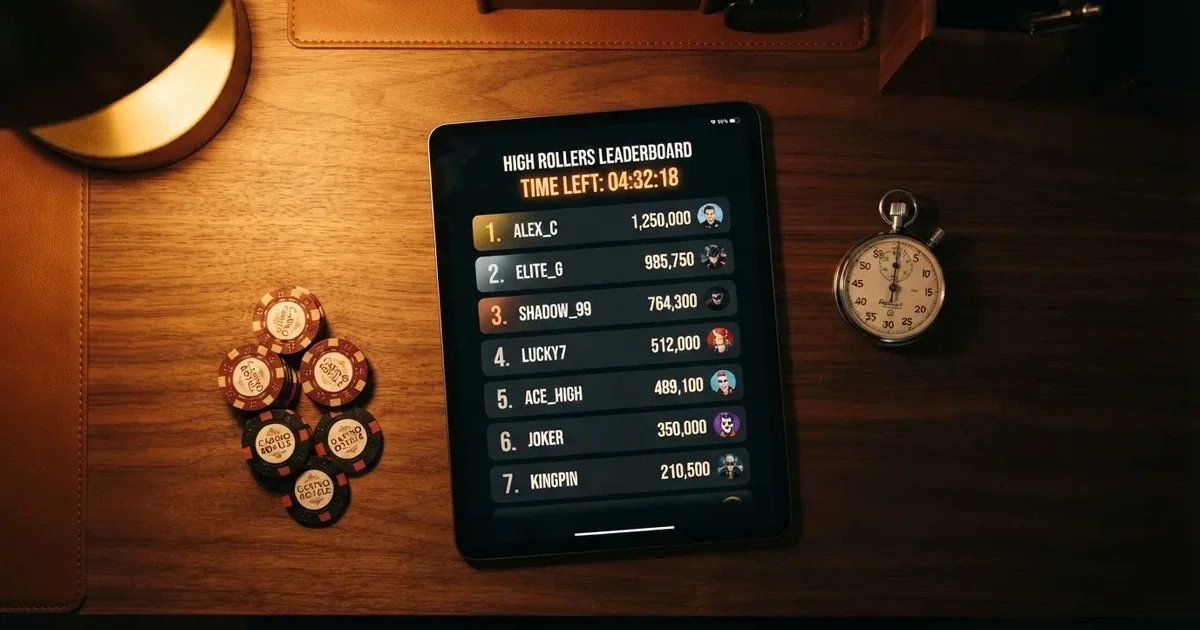
This piece takes the position that a tournament is a marketing wrapper around ordinary slot play, and treats it that way. Where the rules carry a cost the marketing does not name, the cost is on the page. Where a leaderboard looks generous and is in fact tight, the page says so. The reader is here to compare offers, not to be sold to.
Data current as of 7 November 2026, verified against the Gambling Commission’s public register of gambling businesses.
Table of Contents
- The rules every UK tournament sits inside
- How a tournament actually works at the table
- Crypto and the tournament entry question
- How quickly a prize reaches the account
- Where the prize incentives actually sit
- Which slot titles and studios sit on the leaderboard
- The licensed operator set, ranked on what the licence already says
- What an offshore brand cannot offer that a GB-licensed one must
- Responsible play inside the leaderboard mechanic
- Choosing an offer without reading the marketing
- FAQs
The rules every UK tournament sits inside
A tournament cannot run in Great Britain unless the operator holds a remote casino operating licence from the Gambling Commission. The register is the test. On 18 September 2026 it listed 139 businesses with an active remote casino operating licence, and 1065 active domain entries alongside 361 white-label entries — a white-label site trades under another operator’s licence, and the licence holder’s name still sits on the register against the domain. The number format on the register is consistent: a remote casino licence reads account-R-number-suffix, where the first six digits repeat the licence account and the R marks a remote (online) licence. The Commission can be checked directly; the rest is the operator’s own page.
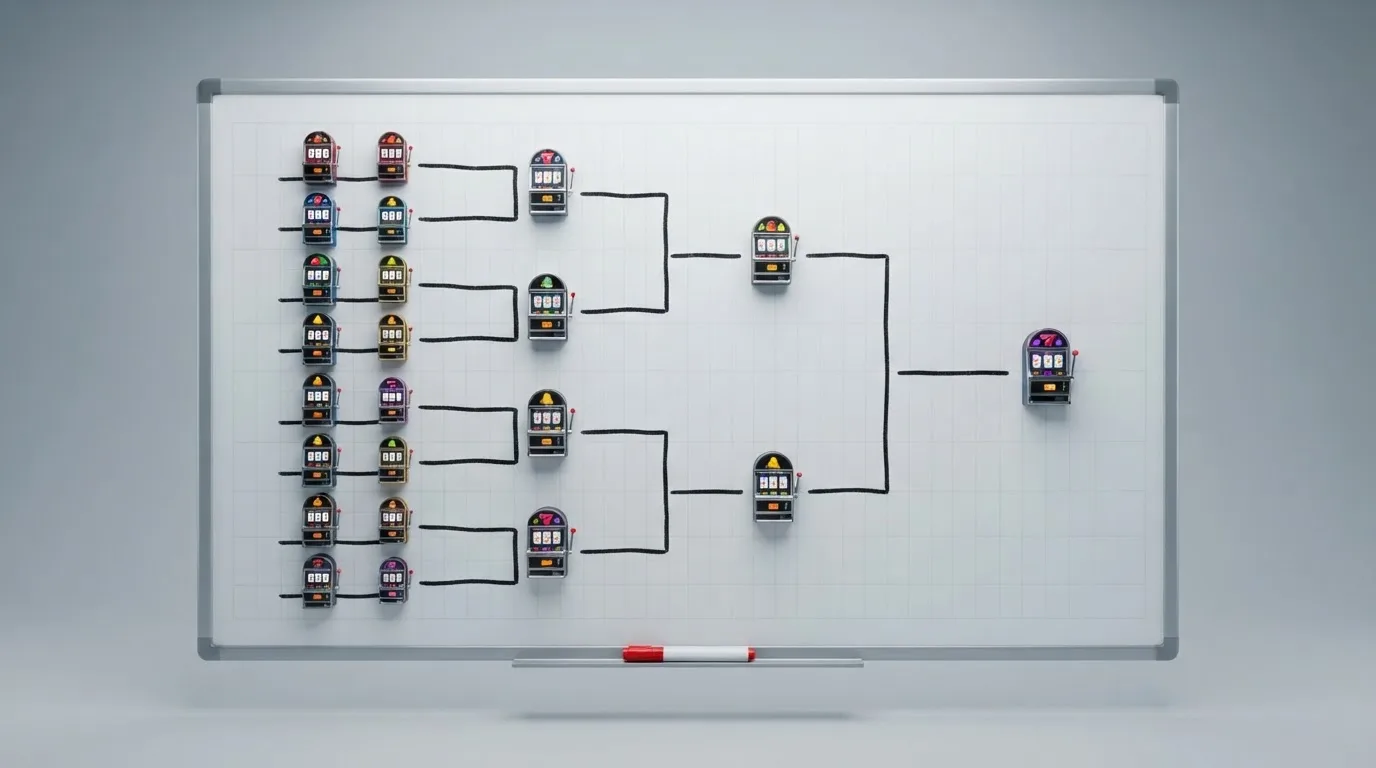
Several major names run under one account. Ladbrokes, Coral and Gala Bingo all sit under LC International Limited, on licence 054743-R-330863-014. Treat them as one operator with three skins, not three competitors — when one of them runs a tournament, the same compliance team and the same wagering cap apply on all three.
Every GB-licensed operator must take part in GAMSTOP, the national online self-exclusion scheme that has been a mandatory licence condition since 31 March 2020. Self-exclusion runs for six months, one year or five years and cannot be cancelled early. A player who has excluded themselves cannot enter a tournament on any GB-licensed site, full stop. The National Gambling Helpline (GamCare) and GambleAware are the national help services; a player who reads this far and recognises a pattern in themselves should reach for one of those before the next leaderboard opens.
Stake caps that apply inside the tournament
Online slots at GB-licensed casinos carry a maximum stake per game cycle. From 9 April 2025 the cap is £5 per spin for players aged 25 and over. From 21 May 2025 the cap is £2 per spin for players aged 18-24. A “game cycle” is one full spin including any re-spins or gamble features that follow from a paid spin. A tournament entry that allows a stake above these caps is, in plain terms, not a GB-licensed tournament; no major operator runs that risk.

Auto-play is banned on slots since 31 October 2021, and a single spin cannot be faster than 2.5 seconds. Tournament windows sometimes run for a week or a fortnight, and the rule of thumb at the slower end is that an hour of full-attention slot play covers roughly 1,440 spins — close to the practical ceiling under the 2.5-second rule. The slower pace changes what “an hour of tournament play” actually delivers in spins, and changes the relative weight of stake size and total volume in the leaderboard math.
Bonuses inside the tournament wrapper
Since 19 December 2025 wagering requirements on casino bonuses are capped at 10x the bonus amount at GB-licensed sites. The same rule banned mixed-product bonuses — a free bet on sport that unlocks casino spins, for instance — so what a player gets is now either a casino bonus or a sports bonus, never a bridge between the two. A tournament prize paid as bonus funds inherits the 10x cap by default, and most operators state the multiplier in the tournament terms. Prize pools paid as cash, withdrawable on completion, sit outside the cap.
The deposit rules that gate entry
Credit cards have been banned for gambling in Great Britain since 14 April 2020. The ban covers credit cards routed through e-wallets, not just credit cards handed to the cashier at sign-up. Debit cards and bank transfers are unaffected, and the Faster Payments Service — operated by Pay.UK since 2008 — moves most UK bank transfers instantly or within minutes, with a £1,000,000 per-transaction scheme limit (individual banks set lower customer limits). Apple Pay is a tokenised front for an underlying card and counts as the card it fronts; a debit card funded through Apple Pay is a debit card for the purposes of the rule, a credit card funded the same way is still a credit card.
Anonymity and verification
Anonymous play is not available at a GB-licensed site. Name, address and date of birth have been verified before the first deposit or any play since 7 May 2019, and the operator is required to run a financial vulnerability check once net deposits cross £150 in a rolling 30 days (from 28 February 2025). Wider financial risk assessments have been announced but are not yet in force. A “no registration” tournament at a brand claiming a UK licence is, on the face of it, not what it claims to be.
The offshore fallback — and what it costs
A Curaçao, Maltese or Gibraltar licence is not a substitute for a Commission licence where the players are in Great Britain. The Gambling (Licensing and Advertising) Act 2014 closed that door, and providing gambling to people in Great Britain without a Commission licence is a section 33 offence under the Gambling Act 2005. The Commission disrupts unlicensed sites — cease-and-desist notices, search-engine delisting, payment and hosting referrals — but has no power to block them at ISP level. The player is not penalised; the player is unprotected. No GAMSTOP coverage, no Commission complaints route, no approved ADR. A tournament at an unlicensed site pays out on the operator’s own terms and offers nothing behind it if the terms are broken.
How a tournament actually works at the table
The structure is uniform across the segment. The operator names a slot — usually one title, occasionally a small group of related titles from one studio. The operator sets a fixed stake for the duration of the tournament, which is in practice the same as the game-cycle stake cap for the player’s age band. The operator sets a window, typically a few days to a fortnight. Every spin during the window counts; the operator tallies the results on a leaderboard that updates in near-real time.
The ranking metric is the player’s best consecutive run of winning spins, the player’s total winnings during the window, or the player’s win-to-stake ratio over a fixed number of spins. Each format rewards a different behaviour. A “best run” format rewards hitting a streak and protects a player whose tournament play was interrupted by an unlucky session; a “total win” format rewards volume and punishes a player who entered late; a “win-to-stake” format rewards efficiency and caps the advantage of a deep-pocketed entrant. The terms page tells the reader which one is in play; the marketing rarely does.
Entry can be free, deposit-gated, or stake-gated. A freeroll asks only for an account in good standing; a deposit-gated tournament asks for a minimum deposit before a place is allocated; a stake-gated tournament asks for a fixed entry fee in real money. Free entries compete for the same prize pool as paid entries in most promotions, with the difference being that paid entries sometimes carry a larger starting stake or extra leaderboard credits. A freeroll at a GB-licensed site is, mechanically, a marketing cost the operator has chosen to absorb — the prize pool is funded out of margin, not out of the entry fee.
Prize pools are paid three ways at GB-licensed operators: cash that withdraws on completion, bonus funds subject to the 10x wagering cap, or free spins on a named slot. Free-spin prizes carry their own wagering treatment depending on how the operator classifies them under the December 2025 rules, and a reader who treats them as cash equivalents is reading the wrong line of the terms.
What a leaderboard prize really delivers
A cash prize on a £10,000 pool paid to the top 50 entrants gives the winner a meaningful sum and the 50th-place finisher a near-meaningless one. The advertised “share of £10,000” is the top of a long tail, and the tail is where most paying entrants finish. The arithmetic of “where on the board do I realistically land” is what an offer costs a player who treats it as a serious proposition, and the offer does not advertise it. A reader who treats a leaderboard as a lottery has read it correctly; one who treats it as a strategy may be disappointed.
Time, attention and the cost of clearing bonus funds
Where the prize is paid as bonus funds, the 10x wagering cap that has applied since 19 December 2025 sets the ceiling on what the operator can demand. A £100 bonus carries a £1,000 turnover requirement; a £500 bonus carries a £5,000 turnover requirement. At the £2 stake cap (for 18-24s) or the £5 cap (for 25+), clearing the requirement demands 500 or 200 spins, respectively. Given the 2.5-second minimum spin interval, a 25-plus player clearing £1,000 at £5 a spin needs 200 spins; 200 spins multiplied by 2.5 seconds per spin equals 500 seconds, or 8 minutes and 20 seconds. A younger player clearing the same turnover at £2 a spin needs 500 spins; 500 spins multiplied by 2.5 seconds per spin equals 1,250 seconds, or 20 minutes and 50 seconds. The gap is the rate cap working as intended—slower stakes, slower clearance, and more time in play.
A bonus-cost calculation is honest about one thing and silent about another. The honest part is the formula: required turnover equals the bonus amount multiplied by the wagering factor. The silent part is what happens during the spins — the house edge is working the whole time, and an unlucky run on the qualifying slot can extend the time to clear by a factor of two or three without any change to the terms. Treat the formula as a planning tool, not a forecast.
Crypto and the tournament entry question
Cryptocurrency deposits work at GB-licensed casinos only inside the operator’s normal KYC and AML framework. The deposit is converted at the operator’s stated rate, the funds are held in sterling or in euro-equivalent pending withdrawal, and the same stake caps and the same wagering cap apply regardless of how the funds arrived. A crypto-funded tournament entry behaves like a sterling-funded one in every respect that matters to the leaderboard math.
The regulatory frame is what closes a few doors that crypto-friendly offshore sites leave open. No anonymous play, no crypto-only tournaments, no bypassing of GAMSTOP. The 18 September 2026 register of 139 active remote casino licence holders is the universe a UK-resident player can use, and every entry on it accepts crypto under the rules that govern the rest of the deposit.
A separate strand of brands advertises “crypto casino tournaments” to a UK-facing audience without holding a Commission licence. The marketing tends to lead with the deposit method and to step around the verification question. The structural point — that an unlicensed site offers no GAMSTOP coverage, no ADR route and no Commission complaint — applies whether the deposit is in pounds, in euros or in BTC. The deposit method is not the protection.
How quickly a prize reaches the account
The Faster Payments Service is the rail most UK operators use for sterling withdrawals. Pay.UK has run the scheme since 2008 and the system operates 24 hours a day, seven days a week. Most Faster Payments transfers arrive instantly or within a couple of minutes, with the upper edge of the published range at around two hours. The £1,000,000 per-transaction scheme limit is high enough that it does not bite on a single tournament prize.
Tournament terms vary on what the operator pays first and what it queues. Most operators run the leaderboard tally in a small batch after the window closes — typically an hour, sometimes overnight — and release the cash side of the prize once the batch confirms. Bonus-fund prizes often arrive as a credited balance and follow the operator’s standard wagering path on the back end. A reader who wants the cash side of a leaderboard prize in the account the morning after the window closes should expect it before lunch; a reader who is hoping for the same on a bonus prize is reading the terms wrong.
Apple Pay and AstroPay both move money into the casino account but neither shortens the leaderboard-to-account leg of a tournament payout. Apple Pay tokenises the underlying card — replacing the real card number with a device-specific Device Primary Account Number and generating a dynamic security code for each transaction — and the receipt at the casino end is a card transaction. AstroPay is a global digital wallet, founded in 2009 and headquartered in Uruguay, with a UK entity authorised by the Financial Conduct Authority under the Electronic Money Regulations 2011. Neither rail changes what the operator does with the prize once the leaderboard has spoken.
Where the prize incentives actually sit
The shelf of incentive formats a British player meets at a GB-licensed casino has narrowed since December 2025. Mixed-product bonuses are gone, so the sportsbook-and-casino bridge that used to land free spins on a casino account from a winning football bet is no longer available. What remains is a cleaner set: cash bonuses with a 10x wagering ceiling, free spins on named slots, freeroll tournaments, and deposit-gated or stake-gated leaderboards.
The freeroll is the format most worth understanding. A freeroll costs the operator the prize pool and nothing else — no entry fee, no qualifying deposit. The player costs the operator the marketing spend, and the operator earns the play time. A player who treats the freeroll as a free lottery has read the offer right; those who view it as a discounted entry into a serious leaderboard often overestimate their odds, as the field is wider and the prize pool is divided across more participants.
A worked band, not a single figure
A wagering-turnover-band calculation illustrates how the 10x cap and the stake caps interact. Two readers, two offers, two outcomes:
For a player aged 25 or over, on a £100 cash bonus with the standard 10x wagering factor, the required turnover is £1,000. At the £5 stake cap, that is 200 spins, which at the 2.5-second minimum spin interval is 500 seconds, or roughly 8 minutes 20 seconds of pure spin time. The house edge on a typical slot at a 96% RTP is 4% over the long run; an expected loss on £1,000 of turnover at that edge is roughly £40. The cash side of a tournament prize that lands as bonus funds costs the player about £40 in expected value, with the time exposure sitting at under ten minutes.
For a player aged 18 to 24, on the same £100 bonus, the turnover is also £1,000, but the £2 stake cap doubles the spin count to 500 and roughly doubles the time exposure to 20 minutes 50 seconds. The expected loss on £1,000 of turnover at a 4% house edge is still about £40 — the stake cap does not change the maths, only the clock. A younger player pays for the bonus in time, not in pounds.
The band the page claims is the one between these two scenarios — roughly 200 to 500 spins, roughly 8 to 21 minutes of pure spin time, and an expected loss of roughly £40 on a £100 cash bonus at a 96% RTP slot, all of it conditional on the wagering factor actually being 10x and the slot actually returning 96%. Where the wagering factor is lower than the cap, the spin count falls; where the slot’s RTP is below 96%, the expected loss rises. The point of stating a band rather than a figure is to keep the reader reading the assumptions, not the number.
The calculation is a statistical estimate over many spins under the stated assumptions, not a forecast of any single player’s outcome. It promises no win, no payout and no return.
Which slot titles and studios sit on the leaderboard
The tournament shelf at a GB-licensed casino leans on a small group of high-volatility titles from a handful of studios, with the same names recurring across operators because the studios run network promotions that several sites join at once. Pragmatic Play’s Drops & Wins network is the most visible example; it sits behind leaderboards at multiple GB-licensed sites and pays from a shared prize pool funded by the studio. NetEnt and Play’n GO titles appear in standalone site-run tournaments, typically on the back of a new release. Big Time Gaming and Nolimit City feature less often at GB-licensed sites than at offshore ones — both studios carry high-volatility titles that pair naturally with leaderboard play, but the GB-licensed shelf has historically run fewer of their games than the offshore shelf, and the gap has narrowed rather than closed.
The specific title on the leaderboard matters more than the studio. A high-volatility slot spends most of its time paying small returns on small stake, with a long tail of rare large wins; on a leaderboard that ranks by total winnings, a high-volatility slot amplifies the gap between the lucky entrant and the unlucky one. A medium-volatility slot pays more often at a lower average size, and the leaderboard finishes closer together. A reader who knows which of the two is on the offer can read the field’s likely shape before the first spin.
Strategy and what it is worth
The word “strategy” in slot tournament marketing is doing heavy lifting. The honest version is mechanical: pick a slot that fits the ranking metric, set the stake at the maximum the rules allow, and play the full window without chasing losses on a slot that is not paying. The dishonest version treats tournament play as a skills exercise, which it is not — slots are random per spin, and the leaderboard reads the cumulative result of that randomness. A strategy that produces a steady win rate is a strategy that has confused slots with a game of decisions; a strategy that keeps the player’s stake at the cap for the full window and stops on a personal time limit is a strategy that respects what the slot is actually doing.
The licensed operator set, ranked on what the licence already says
The set below is not a recommendation. It is the list of ten GB-licensed operators a UK-resident reader is most likely to meet, drawn from the 18 September 2026 Gambling Commission register and ordered to put the cleanest licence picture at the top. Each entry states what the register says about the licence, the domain and the licence holder, and what the page could verify about that operator’s tournament support — which, in most cases, is nothing verifiable at all.
Brand and licence snapshot
| Brand | Licence holder | GB remote casino licence | Domain status on the register | Tournament support |
|---|---|---|---|---|
| Paddy Power | PPB Games Limited | 039411-R-319335-010 | Active domain (Paddy Power) | — |
| Ladbrokes | LC International Limited | 054743-R-330863-014 | Active domain (Ladbrokes.com) | — |
| MrQ | Tek Fox Ltd | 060629-R-337532-004 | Active domain (Mrq.com) | — |
| Coral | LC International Limited | 054743-R-330863-014 | Active domain (coral.co.uk) | — |
| bet365 | Hillside (UK Gaming) ENC | 055149-R-331499-004 | Active domain (Bet365.com) | — |
| Betfred | Petfre (Gibraltar) Limited | 039544-R-319290-010 | Active domain (Betfred) | — |
| Casumo | Recro Limited | 061549-R-336718-002 | Active domain (Casumo.com) | — |
| 888casino | 888 UK Limited | 039028-R-319297-014 | Active domain (888casino) | — |
| Jackpotjoy | Gamesys Operations Limited | 038905-R-319430-022 | Active domain (Jackpotjoy.com) | — |
| Gala Bingo | LC International Limited | 054743-R-330863-014 | Active domain (Gala Bingo) | — |
The pattern the table carries is structural. Eight of the ten brands sit on seven different licences; Ladbrokes, Coral and Gala Bingo all sit on 054743-R-330863-014 under LC International Limited, which is the largest licence cluster on the list and the one a reader is most likely to confuse with three independent operators. MrQ is the smallest by account number on the list (60629) and sits on a relatively recent licence (060629-R-337532-004). Casumo’s licence is the most recent on the table by the same test (061549-R-336718-002, account 61549). The licence numbers tell the reader how long the brand has been on the Commission’s books, not how good the tournament offer is — that is a different question, and the table does not answer it.
The “tournament support” column is empty across the board. That is not a missing row of research; it is what the register itself reports. The register confirms the licence and the domain. It does not catalogue promotions. The honest reading is that the page can confirm a brand is licensed to run a tournament in Great Britain and cannot confirm, from the register alone, whether the brand currently runs one, how often, or on what terms. The terms page on the operator’s own site is the next stop; this comparison stops at the licence.
Paddy Power — broad brand, single licence
Paddy Power sits on licence 039411-R-319335-010 under PPB Games Limited, account 39411. The licence is one of the older remote casino licences on the register by account number, and the domain Paddy Power is listed as active on the 18 September 2026 snapshot. The brand is one of the larger high-street names in UK betting, and the casino arm runs on the same platform as the sportsbook. For a reader looking at tournaments specifically, the relevant question is whether the casino promotions tab carries a leaderboard at any given week — a question the licence register does not answer. The brand’s strength is its range, not its tournament specialism, and the reader should weight that.
Ladbrokes, Coral and Gala Bingo — one licence, three skins
Three names on the list sit on a single licence, 054743-R-330863-014 under LC International Limited, account 54743. They are not three competitors; they are one operator with three brand presentations, and a promotion run on one of them typically runs on the others in the same shape. A reader comparing “Ladbrokes vs Coral” on tournament terms is, in most cases, comparing a brand presentation rather than a different offer, and the comparison ends where the licence number begins. The three brands carry different product biases — Gala Bingo’s heritage is bingo, Ladbrokes’ is sportsbook, Coral’s is mid-market casino — and the promotion shelf reflects that.
MrQ — newer licence, narrower catalogue
MrQ sits on licence 060629-R-337532-004 under Tek Fox Ltd, account 60629, and is the most recently licensed brand on the list by account number. The narrow catalogue is the brand’s identity — fewer titles, fewer studios, a smaller tournament shelf by design. A reader who wants a quieter promotion calendar with fewer overlapping leaderboards has a case for the brand; a reader who wants the broadest tournament choice does not. The smaller licence account is a cleaner match for a smaller operation than for a broad one.
bet365 — largest single-licence operator
bet365 sits on licence 055149-R-331499-004 under Hillside (UK Gaming) ENC, account 55149, and is the largest single-licence operator on the list by footprint. The promotion shelf is correspondingly wide; the tournament shelf runs on the same platform as the rest of the casino, with promotions typically tied to new-release slots or to short windows around major sporting events. The breadth is the offer’s strength and its weakness — the reader sees more promotions, but the tournament shelf shares calendar space with the rest of the casino, and the calendar is busy.
Betfred — high-street heritage, single remote licence
Betfred sits on licence 039544-R-319290-010 under Petfre (Gibraltar) Limited, account 39544. The licence holder’s name hints at the corporate structure (Petfre is the Gibraltar parent), and the Gambling Commission licence is the front door for UK-facing play. The brand’s high-street heritage is the asset; the online casino is the smaller half of the operation by footprint, and the tournament shelf reflects that — narrower than bet365’s, broader than MrQ’s. A reader who values the high-street name and accepts the smaller casino calendar has a case for the brand.
Casumo — most recent licence on the list
Casumo sits on licence 061549-R-336718-002 under Recro Limited, account 61549, and is the most recently licensed brand on the list by account number. The operator is one of the more casino-native names on the shelf and tends to run a denser promotion calendar than the sportsbook-led brands. The licence is clean; the promotion calendar is dense; the reader is choosing between the two.
888casino — long-running casino-only brand
888casino sits on licence 039028-R-319297-014 under 888 UK Limited, account 39028, and is one of the longest-running casino-only brands on the Commission register by account number. The brand’s identity is casino-native, with no sportsbook competing for promotion calendar space. A reader who wants a casino-only operator with a long licence history has a clear case for the brand; a reader who wants a sportsbook bridge does not, because the bridge does not exist at this operator.
Jackpotjoy — bingo heritage, casino arm
Jackpotjoy sits on licence 038905-R-319430-022 under Gamesys Operations Limited, account 38905. The brand’s heritage is bingo, and the casino arm is a smaller slice of the operation than at the sportsbook-led brands. The tournament shelf reflects that — narrower than bet365’s, broader than a bingo-only operation, but not the centre of the brand’s identity.
The structural verdict the table points at
A reader who wants the broadest tournament calendar has the cleanest case for bet365 or Paddy Power — the two largest single-licence brands on the list by footprint, and the two with the most casino-native promotion shelves after 888casino. A reader who wants the cleanest single-operator story has the cleanest case for 888casino — one licence, one brand, no sportsbook to share calendar space with. A reader who wants the newest licence on the list has the cleanest case for Casumo or MrQ — the two most recently licensed operators, and the two most likely to be running promotions designed under the post-December 2025 rule set rather than grandfathered from the older one. A reader who treats the three LC International brands as three competitors will read the table wrong, because they are not.
What an offshore brand cannot offer that a GB-licensed one must
The differences are not in the slot or the leaderboard — the slot is the same Pragmatic Play or NetEnt title either way. The differences are in what sits behind the slot.
A GB-licensed operator runs GAMSTOP, the National Gambling Helpline route, the Commission’s complaints procedure and an approved ADR. An offshore operator runs none of these. A GB-licensed operator applies the £5 / £2 stake cap and the 10x wagering cap; an offshore operator runs on its own house rules. A GB-licensed operator verifies identity before play; an offshore operator can advertise anonymity and mean it. The trade is mechanical: a wider promotion shelf, looser stake and bonus terms, and no protection if the operator stops paying.
The penalty for playing on an unlicensed site is not a criminal one — section 33 of the Gambling Act 2005 targets the operator, not the player. The cost is the absence of recourse. A player who is paid out on an unlicensed site has no Commission complaint to file; a player who is not paid out has no ADR to approach. The Commission’s enforcement toolkit — cease-and-desist notices, payment and hosting referrals, search-engine delisting — works on the operator’s reach, not on the player’s recovery. A reader who treats an unlicensed offer as “the same product, fewer rules” has read the offer correctly and the protection incorrectly.
Responsible play inside the leaderboard mechanic
A leaderboard is, by construction, a competition. The competitor who stops when the personal time limit hits has read the format well; the competitor who chases the next place on the board past that limit is the player the Commission has been writing rules for since 2020. GAMSTOP is the largest of those tools — six months, one year or five years, no early cancellation — and the National Gambling Helpline (GamCare) is the route for a player who is not yet ready to exclude but wants to talk.
The financial vulnerability check that fires at £150 in net deposits over a rolling 30 days (from 28 February 2025) is the second tier: a public-data-only check that prompts a conversation rather than a block. The wider financial risk assessments are announced but not yet in force, and the rule is that they will run on a similar cadence once live. The financial prompt at the first deposit — required since 31 October 2025 — is the operator’s first conversation with the player, and a reader who skips it is reading the wrong end of the operator.
Tournament play stacks three pressures on top of the ordinary slot session: a deadline (the window), a peer comparison (the leaderboard) and a prize at the top. A personal time limit set before the first spin — and respected at the end of the session — is the single most useful tool a player has, and the Commission has built the rest of the framework around the assumption that the player uses it.
Choosing an offer without reading the marketing
The decision tree a reader is actually making has three branches. The first is licence status, and the answer is always the same — GB-licensed, full stop, because the alternative is no recourse. The second is the format of the tournament: freeroll, deposit-gated or stake-gated. A freeroll costs the player nothing but time; a deposit-gated tournament requires a real-money deposit before entry; a stake-gated tournament requires a real-money entry fee. The marketing word for each of these is “free” in some cases and “from £X” in others, and the terms page is where the difference lives.
The third branch is the prize structure. Cash prizes withdraw on completion and cost the player the house edge during play. Bonus-fund prizes inherit the 10x wagering cap and cost the player the house edge plus the wagering time. Free-spin prizes carry their own wagering treatment depending on the operator’s classification. A reader who treats all three as equivalent has read the offer’s headline and missed its body.
The marketing word the page would puncture, if there were a single one to reach for, is “win”. A leaderboard is not a win; it is a slice of a prize pool, distributed unevenly across a long tail, with the house edge working through every spin along the way. The arithmetic on the previous pages does not promise a win, and neither does the offer. A reader who treats the offer as a chance to play a slot at the operator’s expense for the length of the window has read it correctly; any expectation of a guaranteed prize is a misunderstanding of the terms.
FAQs
How do online slot tournaments work at UK casinos?
A licensed operator names a slot, sets a fixed stake and a fixed window, and ranks every entrant by what they win during that window. The stake cannot exceed the £5 (age 25+) or £2 (age 18-24) game-cycle cap, the wagering requirement on any bonus cannot exceed 10x since 19 December 2025, and the operator must be licensed by the Gambling Commission for the offer to be legal in Great Britain.
Can I enter a slot tournament without making a deposit?
A freeroll tournament asks only for an account in good standing and is the standard no-deposit format at GB-licensed casinos. Deposit-gated and stake-gated formats require a minimum deposit or a paid entry fee and are not no-deposit offers, even where the marketing calls them “free to enter”.
What determines my ranking on a tournament leaderboard?
The ranking metric is one of three: best consecutive run of winning spins, total winnings over the window, or win-to-stake ratio over a fixed spin count. Each rewards a different behaviour, and the operator’s terms page states which is in play for any given tournament. The slot’s volatility shapes the distribution of finishes on the board.
How quickly are tournament prizes paid out?
Cash prizes paid through the Faster Payments Service typically arrive instantly or within minutes, with the operator’s own processing window adding the delay. Bonus-fund prizes arrive as a credited balance and follow the operator’s standard wagering path on the back end; the cash side of a prize is faster than the bonus side.
Do crypto deposits count towards tournament entry the same as card payments?
A crypto deposit at a GB-licensed casino is converted at the operator’s stated rate and held in sterling, and the same stake caps, the same 10x wagering cap and the same KYC checks apply. The deposit method does not change the leaderboard mechanics, the prize treatment or the protection framework; it changes only the rail the funds arrived on.
What tips help with slot tournament strategy?
Slots are random per spin, and there is no skills-based route to the top of a leaderboard. The mechanical version of strategy is to set the stake at the maximum the rules allow, play the full window without chasing losses, and stop on a personal time limit. The honest version is that a leaderboard is a lottery with a marketing wrapper, and the player who treats it that way has read the offer correctly.