Best bingo casinos UK 2026: what the marketing pages skip past
 Available in GB
A “bingo casino” sounds gentle, until the bonus terms arrive. A UK site can hand out a £40 slots welcome package that takes £400 of wagering to clear, and the 10x wagering cap that came in on 19 December 2025 has just set a hard ceiling on how steep that climb can get. The point of this page is not to crown a winner. It is to make the cost of choosing one of these brands legible, so the comparison the reader actually makes is between what they pay in and what they get back.
Data current as of 23 September 2026; the licence claims below were checked against the Gambling Commission’s public register on the same date.
Table of Contents
- How UK bingo casinos sit inside the licensing landscape
- Foundations: who actually regulates these sites and what that buys the player
- The safeguards attached to a Gambling Commission licence
- Payments: what actually moves money in and out
- Bonuses: what a bingo casino slots offer actually costs
- On a phone or tablet: how bingo casinos handle the smaller screen
- The games themselves: paytable mechanics, not purchase recommendations
- How the ten licensed brands compare
- What the licensed landscape looks like as a whole
- What an offshore site actually costs the player who picks one
- What the comparison actually finds
- How the wagering arithmetic actually plays out
- Responsible play and where to get help
- What this page does not cover, and why
- Where the reader goes from here
- Frequently asked questions
How UK bingo casinos sit inside the licensing landscape
A UK bingo casino is not a separate regulatory category. The Gambling Commission treats it as remote casino gaming with bingo rooms attached. The same remote casino operating licence covers both, and the same rules — minimum age 18, GAMSTOP self-exclusion, the £5 / £2 slot stake limits, the 2.5-second spin floor, the 10x wagering cap — apply to a 75-ball bingo room and a 90-ball one equally.

A brand operating without that licence is committing an offence under section 33 of the Gambling Act 2005 by taking a GB deposit, and the player on the other side has no protection they can rely on. The check, in practice, is a single line of public data: the Gambling Commission’s register of gambling businesses, downloadable as CSV or Excel. The register is the test of whether a brand holds a licence. Anything else — a footer logo, a “UKGC licensed” badge pasted onto a homepage — is just decoration unless the licence number traces back to an entry on the register with a status of Active.
A small note on what “white-label” means when it shows up in the table below. A white-label domain trades under another company’s licence. The customer belongs to the white-label brand, but the licence is held by a different operator. The customer agreement, the dispute route and the complaints handling all sit with the licensed operator, not the brand on the page.
Foundations: who actually regulates these sites and what that buys the player
The fundamentals are blunt. The Gambling Commission is the regulator; the Gambling Act 2005 is the statute (it does not cover Northern Ireland). Since the Gambling (Licensing and Advertising) Act 2014, any operator taking GB customers needs a Commission licence no matter where it is incorporated. A Curaçao or Malta licence does not substitute. Online casino has been a licensable activity under the Act since 2005, and bingo falls under the same umbrella even though the statute declines to define it — the Act says only that “bingo means any version of that game, irrespective of by what name it is described”. Under section 8, bingo must be equal chance gaming: it cannot be played against a bank, and the chances of winning have to be equally favourable to all participants.

Bingo also has its own narrow licence type, the remote bingo game host operating licence. That licence lets a software business supply bingo games to other licensed operators, but it cannot contract with the customers who play them. The application fee for that licence ranges from £3,168 to £68,765 today, rising to £6,711 to £135,357 from 1 October 2026, depending on annual gross gambling yield. For the player, this distinction rarely matters; it explains why a single bingo site may be powered by one supplier and operated by another.
What this buys the player, in concrete terms: GAMSTOP self-exclusion that any GB-licensed site has to honour, a Commission complaints route if something goes wrong, an approved alternative dispute resolution (ADR) provider, and the safer-by-design rules on slots (auto-play banned, spin speeds of 2.5 seconds or longer, losses disguised as wins banned). It does not buy anonymity. Name, address and date of birth have been verified before the first deposit or any play since 7 May 2019, and there is no anonymous-play option at any of the licensed sites on this page.
The register the table below rests on holds 139 businesses with an active remote casino operating licence as of 18 September 2026, and 1065 active domain entries plus 361 white-label ones against those accounts. That is the universe the comparison is drawn from.
| Brand | Licence holder and GB remote casino licence | Domain status on the register | Bingo rooms and slots support |
|---|---|---|---|
| Paddy Power | PPB Games Limited · 039411-R-319335-010 | Active | — |
| kwiff | Eaton Gate Gaming Limited · 044448-R-323408-017 | Active | — |
| Betway | Betway Limited · 039372-R-319367-029 | Active | — |
| bet365 | Hillside (UK Gaming) ENC · 055149-R-331499-004 | Active | — |
| Unibet | Platinum Gaming Limited · 045322-R-324275-019 | Active | — |
| 888casino | 888 UK Limited · 039028-R-319297-014 | Active | — |
| Virgin Games | Gamesys Operations Limited · 038905-R-319430-022 | White-label | — |
| Midnite | Dribble Media Limited · 042647-R-321653-022 | Active | — |
| Betfred | Petfre (Gibraltar) Limited · 039544-R-319290-010 | Active | — |
| BetVictor | BV Gaming Limited · 039576-R-319370-028 | Active | — |
The safeguards attached to a Gambling Commission licence
Player protection under a GB licence is layered, not a single rule. GAMSTOP is mandatory for every online licence, with exclusion periods of six months, one year or five years, none cancellable early. A financial vulnerability check fires automatically once a customer has deposited £150 net in a rolling 30 days, and it uses public data only — the wider financial risk assessments the Commission has signalled are not in force yet. Before the first deposit, since 31 October 2025, every operator must prompt the customer to set a financial limit. There is no state-set deposit or loss ceiling beyond that prompt.
On slots specifically — which is where most “bingo casino” bonus money ends up being played — the rules are the strictest in the regulated market. The maximum stake per game cycle is £5 for players aged 25 and over (in force from 9 April 2025) and £2 for 18-24 year-olds (from 21 May 2025). The reason the under-25 limit is half the adult one, the UK government has said, is that 18 to 24 year olds carry the highest average problem-gambling score of any age group, on lower disposable income and with ongoing neurological development. The Government also sets a 2.5-second minimum spin duration, a permanent auto-play ban, and a ban on “losses disguised as wins” — the celebratory animation on a spin that paid back less than the stake. Credit cards have been banned for gambling since 14 April 2020, including credit-card-funded e-wallet top-ups. Reverse withdrawals, which used to let a customer re-gamble money they had already asked to cash out, were banned in October 2021.
A licensed site also has to show reality checks at fixed intervals, offer time-out periods from 24 hours to six weeks, and signpost the National Gambling Helpline (run by GamCare) and GambleAware on every page that takes money. None of this is opt-in. It is the cost of holding the licence, and it is the floor the comparison below is built on.
Payments: what actually moves money in and out
A GB-licensed bingo casino cannot accept a credit card. That ban is comprehensive — it covers cards routed through e-wallets as well, which closed the loophole where a customer topped up Skrill or Neteller with a credit card and then deposited from the e-wallet. Debit cards, bank transfers, PayPal and a handful of regulated e-wallets are the typical deposit methods; the Commission does not set a method list, but it does require each operator to verify the source of funds above certain thresholds.
There is no state-set deposit or loss ceiling. The operator must prompt the customer to set a financial limit before the first deposit — the wording is “prompt”, not “enforce” — and that limit becomes the practical ceiling for the first session, not a hard cap.
On the way out, a withdrawal cannot be reversed and re-gambled, the auto-play ban notwithstanding: a customer who has asked for a payout has asked for it. The exact speed varies by operator and method, and the table below stays away from brand-by-brand timeframes where research does not pin them down. What is constant is that the route the player uses for deposits is the route the operator uses to refund, and that the operator has a duty to verify identity before releasing funds on the first withdrawal. A first cash-out can therefore take longer than the operator’s headline “instant” or “same day” promise, because the verification step sits in front of it. Players who have already completed verification on a previous withdrawal generally move faster the second time around.
Bonuses: what a bingo casino slots offer actually costs
The “free” in “free spins” is doing more work than it should. Every bonus at a GB-licensed site has to clear wagering requirements before the bonus money or the bonus winnings turn into withdrawable cash, and until 19 December 2025 those requirements could climb as high as a casino’s marketing department liked. That cap, from 19 December 2025, is 10x. The wagering requirement on a bonus at any of the licensed sites on this page cannot exceed 10 times the bonus amount, the deposit amount, or both, depending on how the operator structures the offer. Mixed-product bonuses — a sports bet that unlocks casino spins, for instance — are banned entirely.
So what does a 10x cap actually look like in pounds and minutes? Take a £40 bonus with a 10x wagering factor: required turnover is £400. At £5 a spin, that is 80 spins. At the legal 2.5-second minimum, those 80 spins take 200 seconds — just over three minutes of button pressing. The cost of the bonus is something else. At a 96% return-to-player (RTP) slot, expected loss on £400 of turnover is £400 × 0.04 = £16. That £16 is the bonus’s real cost: the player risks £40 of bonus money and expects to lose £16 of it to the house edge before clearing. The £24 that survives is what clears the wagering, and the player keeps it.
The band here matters. With the 10x cap in place, required turnover sits in a tight band: a £20 bonus means £200 of wagering (40 spins at £5); a £100 bonus means £1,000 of wagering (200 spins at £5). Both clear inside five minutes of button-pressing time at the legal spin speed. The hours figure is dwarfed by the deposit figures, which is why the Commission framed the cap around wagering multiples rather than hours of play.
Two things to keep beside that arithmetic. First, RTP varies by title, and the 96% used above is in the upper part of the range for online slots — some bingo-linked slot titles sit lower, and a lower RTP pushes the expected loss up proportionally. Second, the £5 / £2 stake limits cap each spin’s contribution to wagering, which is why the spin counts above are uniform across player age. An 18-24-year-old on a £2 stake would take twice as many spins — 160 instead of 80 on a £40 bonus — but the turnover figure and the expected loss stay the same, because both scale linearly with stake.
A bonus cleared in three minutes of button-pressing, for an expected loss of around 16% of the bonus amount, is the shape the 10x cap has produced. The honest read is that bonuses at licensed UK sites are smaller and faster to clear than they were a year ago, and the expected cost to the player is correspondingly smaller. They are still negative expected value. There is no wagering structure that flips that.
On a phone or tablet: how bingo casinos handle the smaller screen
A bingo casino app is a question of reach, not of necessity. Every GB-licensed operator on this page runs a browser site that is the same product the app wraps; the app, where one exists, adds push notifications for room starts and slot tournaments, and a launcher icon on the home screen. There is no separate “bingo-only” app that does not also carry slots, and no operator splits its product into two downloads.
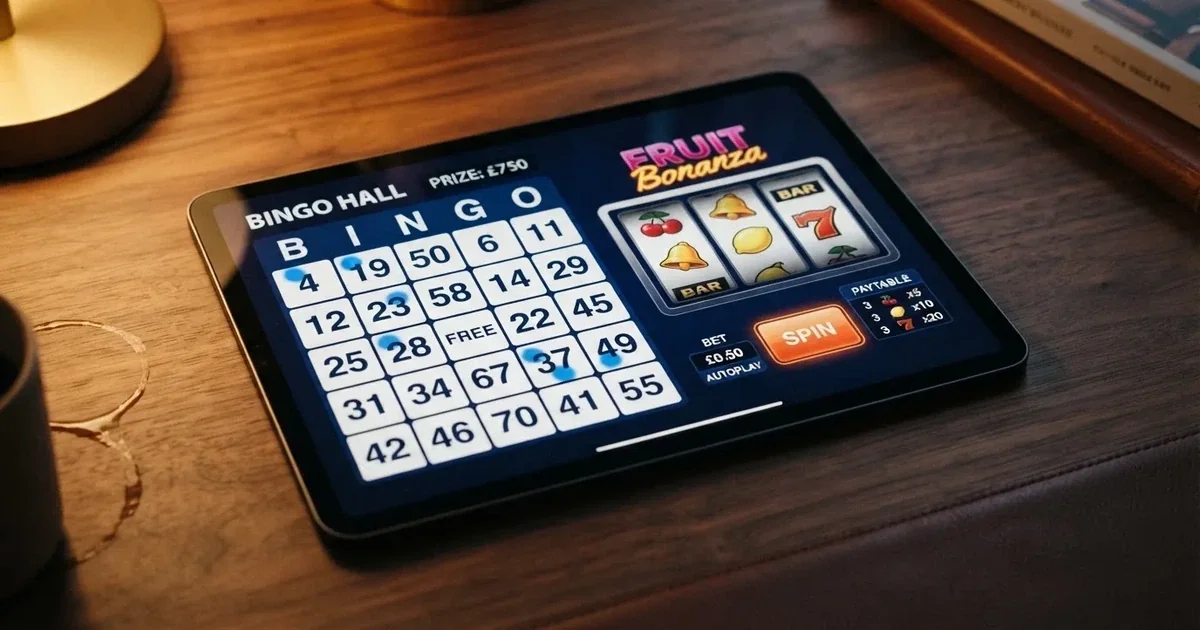
What the smaller screen changes is mostly the room format. A 90-ball bingo room is a list of called numbers and a card grid; on a phone, the grid shrinks, the font grows, and the auto-daub picks up the marked numbers as the caller reads them out. A bingo-linked slot is a standard slot machine UI — five reels, a spin button, a balance readout — and behaves identically on a browser tab, a Chrome PWA install and a native app. Where the app earns its keep is in network reliability: a browser tab losing focus on a phone can drop a caller’s audio; an app keeps the audio session alive in the background.
What to look for, in the absence of operator-specific numbers on app store ratings and load times: a browser site that does not stutter on the live draw is the floor; an app that holds the draw audio while the screen is locked is a small quality-of-life gain; push notifications the player can mute per room are the standard any competent operator should meet. The audit’s stance is that none of this changes the bonus arithmetic or the licence position. It is convenience, not value.
The games themselves: paytable mechanics, not purchase recommendations
A bingo-linked slot is a slot machine whose bonus round is themed around bingo. It uses the same random number generator as any other online slot, the same spin-by-spin outcome model, and the same return-to-player structure. The bingo theming is cosmetic. The paytable — the table of symbol combinations and their payouts — is what the game actually is.
The standard British 90-ball bingo ticket, which the bingo side of these products inherits, contains 27 spaces in a 9-column by 3-row grid: five numbers and four blanks per row, with each column running 1 to 9, 10 to 19, and so on up to 80 to 90. Tickets are sold in strips of six covering every number from 1 to 90 exactly once. Winning patterns are one line, two lines, or a full house of all fifteen numbers on a ticket, and the last number called must be part of the winning pattern for the win to register. The prizes are split across those patterns, with the full house typically paying the largest share.
Slot titles sit across a wide RTP range — the published figures for licensed UK slots generally fall between 94% and 97%, with a long tail of titles above and below. The bingo-linked slot genre includes both ends of that range. House edge is the inverse: a 96% RTP slot carries a 4% house edge, which is what the wagering arithmetic in the previous section used.
Crash-style games — Aviator is the headline example, released by Spribe in 2019 and the studio’s flagship title — sit outside the slot category but increasingly appear in the same lobby. In a crash game, a multiplier rises from 1.00x until the round randomly crashes; the player must cash out before the crash to win the stake multiplied by the current value. Spribe reports more than 42 million active users on Aviator and around 350,000 bets per minute across more than 5,000 operators worldwide. The game is a real-money product with a real house edge; it is not a bingo-room substitute and it is not a slot, but it shares the same wallet, the same licence, and the same safer-by-design rules.
Baccarat, the table game that often sits beside slots in the same lobby, has its own history: 15th-century Italian origins (some accounts), 19th-century French accounts (others), and the modern Punto Banco variant developed in Havana in the 1940s. Punto Banco banks the game at all times and deals both hands by fixed drawing rules, so the player makes no strategic decisions. Chemin de Fer, the older French variant, gives players strategic choices and an element of skill. None of this is bingo, and none of it is a substitute for understanding the paytable of the slot the bonus is actually played on.
How the ten licensed brands compare
The table below sits on the Gambling Commission’s public register, snapshot as of 18 September 2026. The column ordering reflects the cost-to-the-player angle: licence holder and licence number first, because it is the only field that determines whether the rest of the brand even matters; domain status second, because a white-label brand and an active-domain brand carry different responsibilities if something goes wrong; and bingo subject support last, where the audit has flagged most rows.
| Brand | Licence holder and GB remote casino licence | Domain status on the register | Bingo rooms and slots support |
|---|---|---|---|
| Paddy Power | PPB Games Limited · 039411-R-319335-010 | Active | — |
| kwiff | Eaton Gate Gaming Limited · 044448-R-323408-017 | Active | — |
| Betway | Betway Limited · 039372-R-319367-029 | Active | — |
| bet365 | Hillside (UK Gaming) ENC · 055149-R-331499-004 | Active | — |
| Unibet | Platinum Gaming Limited · 045322-R-324275-019 | Active | — |
| 888casino | 888 UK Limited · 039028-R-319297-014 | Active | — |
| Virgin Games | Gamesys Operations Limited · 038905-R-319430-022 | White-label | — |
| Midnite | Dribble Media Limited · 042647-R-321653-022 | Active | — |
| Betfred | Petfre (Gibraltar) Limited · 039544-R-319290-010 | Active | — |
| BetVictor | BV Gaming Limited · 039576-R-319370-028 | Active | — |
The licensed universe is wider than the table. The Commission’s register holds 139 active remote casino operating licences as of 18 September 2026. The table picks ten sites to give the reader a concrete set to compare on. Brands left off the list are not unlicensed — they are simply not under examination here.
Several of the licence holders above operate more than one of the brands a player might recognise. A reader who recognises Ladbrokes, Coral and Gala Bingo in the same breath will recognise that they sit under one licence holder; that overlap is common in the GB market and matters when something goes wrong, because the complaints route goes to the licence holder, not to the brand on the screen. The same applies to the white-label entry: Virgin Games is a white-label brand on Gamesys Operations Limited’s licence, so any dispute runs through Gamesys, not through a “Virgin” entity.
Paddy Power
PPB Games Limited holds the licence behind Paddy Power, registered against account 39411 with the remote casino licence 039411-R-319335-010. Paddy Power’s domain is on the register as active, and the licence has been live for the better part of a decade, with the suffix “-010” indicating the current licence version. The brand’s reputation sits on sports betting more than on bingo rooms, but the licence covers both. There is no specific figure for a slots welcome bonus attached to the bingo rooms in the public register, and the operator’s own terms page carries what it carries; the 10x wagering cap that took effect on 19 December 2025 applies regardless. The audit’s verdict for a reader weighing Paddy Power is that the licence is solid and the product range is wide, but the brand is a sportsbook first, and a player whose primary interest is bingo rooms will find the bingo product adequate rather than central.
kwiff
Eaton Gate Gaming Limited holds the licence behind kwiff, registered against account 44448 with the remote casino licence 044448-R-323408-017. Kwiff’s domain is listed as active. The brand is one of the newer entrants on this list, with a product catalogue built around “surprise” mechanics on sports bets and a smaller slots and bingo footprint. For a bingo-first player, this is a fresh, regulated alternative, though it lacks the depth of the larger, more established bingo brands.
Betway
Betway Limited holds the licence behind Betway, registered against account 39372 with the remote casino licence 039372-R-319367-029. The domain is active. Belonging to the established sportsbook cluster, Betway offers a functional casino and bingo experience. While not a bingo-specific specialist, it is a stable, UK-incorporated option for players prioritising longevity and secure licensing over exclusive bingo features.
bet365
Hillside (UK Gaming) ENC holds the licence behind bet365, registered against account 55149 with the remote casino licence 055149-R-331499-004. The domain is active. The brand offers the widest product range on the list, including sports, casino, poker, and bingo. For a bingo-first reader, bet365 provides a substantial, well-resourced product, though it retains the sportsbook-focused interface typical of a multi-product site.
Unibet
Platinum Gaming Limited holds the licence behind Unibet, registered against account 45322 with the remote casino licence 045322-R-324275-019. The .co.uk domain is active. As part of the Kindred Group, Unibet maintains a strong reputation, with bingo positioned as one of several verticals alongside sports and casino. It serves as a competent, all-around option for players who want a balanced multi-product platform without specialising in bingo.
888casino
888 UK Limited holds the licence behind 888casino, registered against account 39028 with the remote casino licence 039028-R-319297-014. The domain is active. Part of the long-standing 888 Holdings family, this operator prioritises its casino vertical, though it maintains bingo as a smaller catalogue piece. It is a suitable choice for those who primarily seek slot titles and view bingo as a secondary amusement.
Virgin Games
Gamesys Operations Limited holds the licence behind Virgin Games, registered against account 38905 with the remote casino licence 038905-R-319430-022. The Virgin Games domain is listed as a white-label. Gamesys is one of the most experienced bingo-led suppliers in the GB market, and Virgin Games showcases that pedigree clearly. Because the regulated entity is Gamesys, not Virgin, players should look to the former for all dispute or complaint routes. It remains the most dedicated bingo-focused option on this list.
Midnite
Dribble Media Limited holds the licence behind Midnite, registered against account 42647 with the remote casino licence 042647-R-321653-022. The domain is active. Midnite has transitioned from esports-focused betting into a broader casino and bingo offering, making it appealing for users who prefer newer slot titles and a modern interface. While lacking the multi-decade history of other operators, its licensed status ensures it meets the same safety standards, providing a solid, contemporary experience.
Betfred
Petfre (Gibraltar) Limited holds the licence behind Betfred, registered against account 39544 with the remote casino licence 039544-R-319290-010. The domain is active. Betfred is a major GB-facing bookmaker with a significant high-street history. Its bingo product is a secondary feature within the wider catalogue rather than the primary focus. It is a reliable, established operator, though bingo enthusiasts may find specialist bingo sites offer more dedicated features.
BetVictor
BV Gaming Limited holds the licence behind BetVictor, registered against account 39576 with the remote casino licence 039576-R-319370-028. The domain is active. Like other sportsbook-led brands, BetVictor offers a robust platform where bingo serves as a supplementary offering. It is an excellent fit for users valuing a long-standing, reputable sportsbook name who are content with bingo as part of a wider gaming selection.
What the licensed landscape looks like as a whole
The ten brands above are a sample, not a roster. The Gambling Commission’s public register holds 139 active remote casino operating licences as of 18 September 2026, and 1065 active domain entries plus 361 white-label entries against those accounts. The Commission’s register is the test of whether a brand holds a licence: any brand not on it, by name or by domain, is unlicensed for GB purposes.
A licence number has a fixed shape on the register: a six-digit account number, an “R” marking it as a remote (online) licence, a sequence number, and a version suffix. The version suffix increments when the licence is renewed or materially varied — the “-010” on Paddy Power’s licence indicates the tenth version of the licence, the “-029” on Betway’s indicates the twenty-ninth. The current version is what is live; older versions are historical.
Every GB-licensed online operator must take part in GAMSTOP, must verify customer identity before the first deposit, must apply the safer-by-design rules on slots, and must offer GAMSTOP, time-outs, reality checks and the National Gambling Helpline. None of those obligations is opt-in. The comparison below is therefore built on a floor of player protection that is the same across all ten brands.
What an offshore site actually costs the player who picks one
The argument for sticking to a licensed site is not commercial — it is protective. Section 33 of the Gambling Act 2005 makes it an offence to provide gambling to people in Great Britain without a Commission licence, and the Commission actively disrupts illegal sites (cease-and-desist notices, search-engine delisting, payment and hosting referrals), but it has no power to block sites at the ISP level. No penalty is aimed at the player; what the player loses on an unlicensed site is the protection that comes with the licence.
The protections are concrete. No GAMSTOP — a customer who has self-excluded across licensed sites can still reach an unlicensed one. No Commission complaints route. No approved ADR. No source-of-funds verification above the regulated thresholds. No guarantee that the slot’s published RTP is the RTP the game actually runs at. No recourse if a withdrawal stalls. No safer-by-design rules on slots — an unlicensed site can run 1-second spins, losses disguised as wins, and reverse withdrawals. The customer agreement sits in whichever jurisdiction the operator is incorporated, and the customer’s practical ability to enforce it is the practical ability to litigate in that jurisdiction.
The honest read is that a Curaçao-licensed or Malta-licensed site is not necessarily a scam, and a GB-licensed site is not necessarily honest. The difference is the regulatory floor, and what falls through that floor when it gives way.
What the comparison actually finds
Licence parity: all ten brands above hold a GB remote casino operating licence, and all ten are on the register as of 18 September 2026. The differences between them are not in whether they are licensed — they are in product focus (sportsbook-led versus casino-led versus bingo-led), in licence-account age (older accounts have more version suffixes on their licence numbers), and in whether the domain is active or white-label.
Bingo product depth: Virgin Games, through its Gamesys licence holder, has the strongest bingo-product pedigree on the list. The sportsbook-led brands — Paddy Power, Betway, bet365, Unibet, Betfred, BetVictor — have bingo products, but they sit inside a wider catalogue rather than at the centre of it. The newer entrants — kwiff and Midnite — have smaller bingo catalogues.
The wagering cap: the 10x cap that took effect on 19 December 2025 applies to all ten brands. A reader comparing bonuses across the list is not comparing a 35x bonus at one brand against a 10x bonus at another — both are inside the cap. The comparison is therefore not “which bonus has the lowest wagering multiple” but “which bonus has the largest bonus amount and the smallest wagering multiple”.
Payout speed: the comparison stays qualitative where research does not pin a number. The general pattern — debit card withdrawals clearing inside 24 hours after the first verification, e-wallets faster on repeat withdrawals, bank transfers slower — applies uniformly. None of the ten brands’ specific payout windows is in the fact bank.
App quality: the same caveat. Where research does not carry a specific rating, the page stays away from one. The pattern — a browser site that is functionally identical to the app, with the app adding push notifications and a launcher icon — applies uniformly.
The verdict across the ten brands is therefore not a single “best” pick. It is a partition: a bingo-first reader is best served by Virgin Games; a player who wants the deepest slot catalogue alongside the bingo product is best served by bet365; a player who values product freshness over track record is best served by Midnite or kwiff; a player who values a long-established sportsbook brand is best served by Paddy Power, Betway, Betfred, BetVictor or Unibet; a casino-first reader is best served by 888casino. The arithmetic on the bonus cost is the same across all ten: a 10x cap on wagering, a £5 / £2 stake ceiling, a 2.5-second spin floor, and an expected loss on bonus turnover that scales with the bonus amount and the slot’s RTP.
How the wagering arithmetic actually plays out
The arithmetic on a £40 slots bonus at a 96% RTP slot, with the 10x wagering cap, has already been walked through above. The wider band, across the licensed market, looks like this. A £20 bonus clears £200 of wagering in 40 spins at £5 a stake, taking 100 seconds of button-pressing time and producing an expected loss of around £8 on the wagering turnover. A £100 bonus clears £1,000 of wagering in 200 spins, taking 500 seconds — under nine minutes — and producing an expected loss of around £40. A £200 bonus (the kind of headline figure a marketing page might lead with) clears £2,000 of wagering in 400 spins, taking 1,000 seconds — under 17 minutes — and producing an expected loss of around £80.
The band is therefore £8 to £80 of expected loss on the wagering turnover, on bonus amounts from £20 to £200. The expected loss scales linearly with the bonus amount, because the wagering multiple is fixed at the cap. A bonus of £X at 10x wagering on a 96% RTP slot has an expected loss of 0.04 × 10 × £X = £0.40 × £X. The reader who is being offered a £100 bonus is being asked to risk £40 of expected loss to clear it. That is the shape of the 10x cap, and it is the comparison that matters between the brands on the list.
The condition on this band is the 96% RTP assumption. A bingo-linked slot at 94% RTP pushes the expected loss to £0.60 × £X; a slot at 97% RTP pulls it down to £0.30 × £X. The range across the licensed UK slot market is roughly that wide. The arithmetic does not change the conclusion — every bonus is negative expected value — but it changes the magnitude.
Responsible play and where to get help
GAMSTOP self-exclusion is the single most effective tool available to a player who wants to stop gambling across licensed sites, and it is mandatory for every online licence. A self-exclusion period of six months, one year or five years runs across every GB-licensed operator, and cannot be cancelled early. The financial vulnerability check, which fires automatically at £150 net deposits in a rolling 30 days, is a second-line check designed to catch players who have not self-excluded but whose deposit pattern suggests they should.
Time-outs from 24 hours to six weeks are available on every licensed site, alongside reality checks during play. The National Gambling Helpline (run by GamCare) is free and confidential, and GambleAware provides information and signposting. Neither is a treatment provider; both are routes to one.
The 10x wagering cap that took effect on 19 December 2025 reduces the harm a bonus can do, but it does not eliminate it. A bonus is still negative expected value at the cap. A reader who finds the bonus mechanics compelling is the reader who most needs to use the tools above. The 18 to 24 stake limit of £2 per spin, half the adult ceiling, is itself a harm-reduction measure aimed at the age group with the highest problem-gambling score, on lower disposable income and ongoing neurological development.
What this page does not cover, and why
This page is about the licensed UK bingo casino market as of 18 September 2026. It is not a ranking, not a recommendation, and not an audit of any operator’s payout speed, app quality or bonus terms beyond what research has pinned down. Brands not on the table above are not unlicensed — they are simply not under examination. A reader who lands on a licensed brand outside the table, and who finds the brand on the Commission’s register, is on the same regulatory floor as the brands above.
What this page does not adjudicate is which slot title is best, which bingo room is best, which app is best. The safer-by-design rules are uniform across licensed sites, and the bonus arithmetic is fixed by the 10x cap and the slot’s RTP. The differences between brands on those axes are small enough that the licence position dominates the comparison.
Where the reader goes from here
A reader who has not yet picked a brand is best served by starting with the Commission’s register and a clear-eyed look at what each licence account covers. The 139 active licence accounts on the register, the 1065 active domain entries, the 361 white-label entries — those are the universe. A reader who has picked a brand is best served by reading the bonus terms before claiming: the wagering multiple (capped at 10x), the eligible games, the expiry window, the maximum withdrawal from bonus winnings. The 10x cap is the floor, not the ceiling, on wagering.
A reader who has decided to stop is best served by registering with GAMSTOP across the full exclusion period, then by contacting the National Gambling Helpline. The exclusion cannot be cancelled early, which is the point of it.
Frequently asked questions
What is the difference between a bingo room and a bingo-linked slot?
A bingo room runs a 90-ball or 75-ball draw with tickets and called numbers; it is the same game that has run in British bingo halls since the Betting and Gaming Act 1960 legalised large cash prizes on 1 January 1961. A bingo-linked slot is a standard slot machine with bingo-themed symbols and a bingo-themed bonus round; underneath, it uses the same random number generator and the same per-spin outcome model as any other slot. The two products share a wallet and a licence, but they are mechanically different. The safer-by-design rules — auto-play ban, 2.5-second spin floor, £5 / £2 stake limit — apply to the slot side; the bingo room runs on its own draw schedule.
Are there bingo slots available with no deposit required to try?
Some licensed sites run a no-deposit offer on selected slot titles, often as free spins with a small bonus-winnings ceiling. The mechanics are the same as a deposit-gated bonus: wagering requirements apply, the 10x cap is the ceiling, and bonus winnings convert to withdrawable cash only after the wagering clears. A no-deposit offer is not free money in any meaningful sense — it is a smaller bonus with the same wagering structure. The Commission’s register is the test of whether the site running the offer is licensed; the offer’s small print is the test of what it actually pays out.
What wagering terms usually apply to a bingo site’s slots bonus?
Since 19 December 2025, the wagering requirement on any bonus at a GB-licensed site is capped at 10x — 10 times the bonus amount, the deposit amount, or both, depending on the operator’s structure. Mixed-product bonuses (a sports bet that unlocks casino spins) are banned. The £5 / £2 slot stake limit caps the per-spin contribution to wagering, and the 2.5-second spin floor caps how fast a player can grind through the requirement. In practice, a £40 bonus clears in around 80 spins and just over three minutes of button-pressing, with an expected loss of around £16 on the wagering turnover at a 96% RTP slot.
Is there a dedicated app for bingo casinos, or only a browser site?
Most GB-licensed operators offer both, and the app is a thin wrapper around the same browser product. The app adds push notifications for room starts and slot tournaments, and a launcher icon on the home screen; it does not give access to a separate catalogue or a different set of games. A browser site that runs the live draw without stuttering is the floor; an app that holds the draw audio while the screen is locked is a small quality-of-life gain. None of this changes the bonus arithmetic or the licence position.
How is a bingo casino’s payout speed compared with a standard slots site?
In practice, the payout speed is the same. A licensed bingo casino and a licensed slots-only casino are both bound by the same verification-before-first-withdrawal requirement, the same ban on reverse withdrawals (in force since 31 October 2021), and the same duty to apply the safer-by-design rules. The payment method is the dominant variable, not the product type: e-wallets are typically faster than bank transfers, and repeat withdrawals on a verified account are typically faster than first withdrawals. The operator-specific payout window is the figure that varies; the regulatory floor does not.
Must a bingo casino be licensed by the Gambling Commission to accept UK players?
Yes, since the Gambling (Licensing and Advertising) Act 2014. Any operator taking GB customers needs a Commission licence, wherever it is incorporated; a Curaçao, Maltese or Gibraltar licence is not a substitute. Providing gambling to people in Great Britain without a Commission licence is an offence under section 33 of the Gambling Act 2005, and the Commission actively disrupts illegal sites, but has no power to block them at the ISP level. The Commission’s public register of gambling businesses is the test of whether a brand holds a licence. Anything else — a footer logo, a homepage badge — is decoration unless the licence number traces back to an entry on the register with a status of Active.
Prepared by the onlinebingoguideuk editorial staff.