How UK players actually move money at online casinos in 2026
 Available in GB
A UK online casino account is one of the few consumer products that cannot be paid for with a credit card, that asks for a passport before it asks for a £10 deposit, and that has a regulator standing between the customer and the cashier’s button. Those three facts shape every payment method on this page, and they are why “best” here has a different answer than in most comparisons. The method that suits a player depends on whether the casino can accept it, whether the player’s bank will release it, and whether the regulator’s safer-gambling guardrails make it usable at all. Below, the payments and payout speed shelf is the spine of the page — the place where the comparison actually lives. It is bracketed by the legality and regulation shelf, which sets the ground rules, and the responsible gaming shelf, which sets the budget rules. Around those sit the top 10 comparison of Gambling Commission licensees and a fundamentals opening that explains why the list looks the way it does.
Current as of 23 September 2026 and cross-checked against the Gambling Commission’s public register of gambling businesses.
Table of Contents
- The licence behind the cashier: how UK online casino payment methods are regulated
- The deposit limit every UK player meets first
- What the cashier accepts: UK online casino payment methods in 2026
- The 10x wagering cap and what it costs
- Comparing ten UK-licensed online casinos for payment-method fit
- What “best” actually means for a UK player
- Closing the comparison: where the cashier stops being the question
- Frequently asked questions
The licence behind the cashier: how UK online casino payment methods are regulated
A “UK online casino” is, in law, a website holding a Gambling Commission remote casino operating licence — and the cashier is part of that licence, not an addon. The Gambling Act 2005 covers Great Britain (England, Scotland and Wales; not Northern Ireland), and since the Gambling (Licensing and Advertising) Act 2014 any operator taking customers in Great Britain needs a Commission licence wherever it is incorporated. A Curaçao, Malta or Gibraltar licence is not a substitute, and treating one as if it were is the most expensive confusion a UK player can make at the deposit screen.

The Commission’s public register is the test. It can be searched online or downloaded in full as CSV or Excel. On 18 September 2026 it listed 139 businesses holding an active remote casino operating licence; the domain list it carries records 1,065 active website entries and a further 361 white-label domains, which trade under another company’s licence rather than their own. A licence number has the shape (account)-R-(number)-(suffix) — the leading six digits repeat the licence holder’s account number and the “R” marks a remote (online) licence, so 038905-R-319430-022 is the remote casino licence of Gamesys Operations Limited (account 38905), under which Virgin Games and Jackpotjoy both sit. Two familiar-looking brands, one licence, one compliance regime — a structure that recurs across the market and explains why “independent casino” is a phrase to be wary of. Virgin Games is listed on the Gambling Commission register as a white-label domain of account 38905, licence 038905-R-319430-022.
What the licence obliges an operator to do is the part that matters at the cashier. Three obligations bear directly on payment methods:
- Identity checks before the first deposit. Since 7 May 2019 the LCCP (Licence Conditions and Codes of Practice) has required operators to verify name, address and date of birth before accepting a deposit or any play. The check runs against public data and against documents the customer supplies; a deposit that would clear in two minutes on a non-UK site can stall here for 24-72 hours while the operator confirms the customer is who they say they are and is not on GAMSTOP.
- Source-of-funds and financial vulnerability checks. From 28 February 2025 a light-touch financial vulnerability check runs at £150 net deposits in a rolling 30-day window, using public data only. Heavier financial risk assessments have been announced but were not in force at the time of writing. The point is that a deposit button can prompt a “where is this money coming from?” conversation even on a modest bankroll, and a player who has not thought about that answer in advance is the player who finds their withdrawal held.
- Mandatory GAMSTOP registration. Every online licence requires the customer to be checked against GAMSTOP, the national self-exclusion scheme, before play. Self-exclusion is for six months, one year or five years and cannot be cancelled early; an excluded player cannot deposit through any method, on any UK-licensed site, until the exclusion expires.
Offshore operators are a different regime and a different cost. Providing gambling to people in Great Britain without a Commission licence is an offence under section 33 of the Gambling Act 2005. The Commission disrupts illegal sites — cease-and-desist notices, search-engine delisting, payment and hosting referrals — but has no power to block them at ISP level, so they remain reachable. What a player loses by using one is protection, not money: no GAMSTOP, no Commission complaints route, no approved ADR (alternative dispute resolution), and a cashier that does not ask the questions a UK cashier is required to ask. The deposit screen on an unlicensed site is faster for a reason, and the reason is that nothing on it is required to be slow.
The deposit limit every UK player meets first
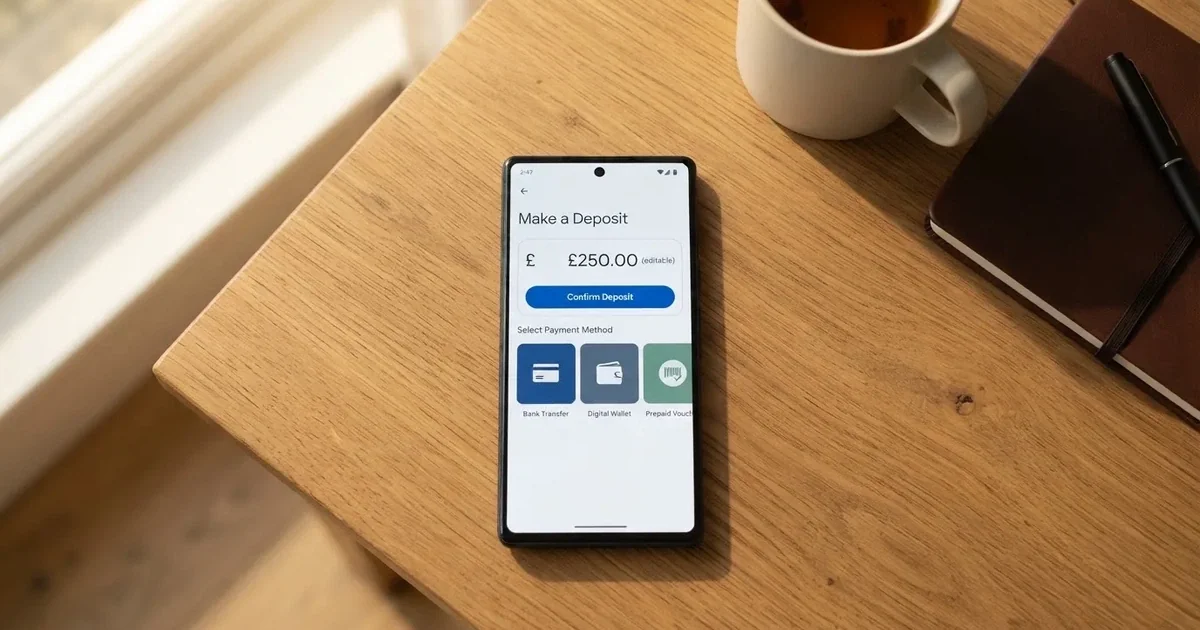
Before the first deposit is accepted, an operator must prompt the customer to set a financial limit. The rule took effect on 31 October 2025; there is no state-set ceiling, so the limit is the player’s own, but it has to be set. This is the moment the responsible-gaming shelf meets the payments shelf, and it is the moment a comparison of payment methods should pause: the best deposit method is the one that lets a player keep the limit they just set, not the one that lets them blow past it.
The wider safer-gambling frame is denser than most readers expect. Game-cycle stake limits have applied to online slots since the spring of 2025: £5 per spin for players aged 25 and over from 9 April 2025, and £2 per spin for players aged 18-24 from 21 May 2025. Autoplay has been banned since 31 October 2021; a slot spin may not complete faster than 2.5 seconds; “losses disguised as wins” — sound effects and animations that frame a losing spin as a win — are banned. These rules narrow the room in which a payment method can move money quickly, and they are why a method that is “instant” at the cashier’s button is not the same thing as a method that lets a player deposit and spin 200 times in five minutes.
For players who want to step back, GAMSTOP is the lever. The National Gambling Helpline (run by GamCare) and GambleAware sit beside it. Time-outs and self-exclusion at a single operator are also available and are independent of GAMSTOP — a player who wants to step back from one brand only does not have to exclude from the whole market to do it. What no payment method can do is opt the player out of any of this. The cashier is regulated; the budget rule sits above it.
Two notes that recur through the rest of this page:
- Credit cards are not an option. From 14 April 2020 the Gambling Commission banned the use of credit cards to fund gambling across all online and offline products in Great Britain, with the narrow exception of non-remote lotteries paid for face-to-face. The ban extends to credit cards routed through e-wallets — paying for an e-wallet top-up with a credit card and then gambling from the wallet is not a workaround. Debit cards and bank transfers were unaffected. The Commission’s reasoning rested on its finding that 22% of online gamblers who used credit cards to fund gambling were classed as problem gamblers, against an estimate of around 800,000 UK consumers using credit cards to gamble in 2018. The data is older than the rule, but the rule is what governs the cashier.
- Bonuses have a ceiling. Since 19 December 2025 wagering requirements on bonuses have been capped at 10x the bonus amount, and mixed-product bonuses — bet on sport, get casino spins — are banned. That cap matters to a payments comparison because a bonus that takes £4,000 of wagering to clear is a different cost from one that takes £400, and a £50 bonus at 10x wagering is £500 of turnover before a penny can be withdrawn. The arithmetic of that sits in its own section further down.
Anonymous play is not possible at a licensed site. A player who wants to deposit and play without showing ID is, by definition, playing somewhere that is not regulated by the Gambling Commission, and the protections attached to a UK licence do not travel with the money.
What the cashier accepts: UK online casino payment methods in 2026
The shelf that justifies the page’s existence is the payments shelf, and it breaks into the methods a UK-licensed casino can actually offer. Six method families cover almost everything the cashier will show.
Debit cards. Visa Debit and Mastercard Debit are accepted at every UK-licensed online casino. Deposits are typically instant at the cashier; withdrawals are returned to the same card and are usually the fastest card route because the operator already has the card on file. The credit-card ban does not touch debit cards, but it does mean a card issued as “Visa” or “Mastercard” without a debit designation will be declined — a prepaid card that runs on the credit rails is not a substitute. The everyday ceiling on a debit-card deposit is the player’s own bank limit, which is often higher than the casino’s safer-gambling prompt and lower than the £1,000,000 Faster Payments ceiling.
E-wallets. PayPal, Skrill, Neteller, Apple Pay (where supported as a wallet rather than as a card tokenisation) and AstroPay are common. PayPal is the most widely accepted at UK-licensed sites; Skrill and Neteller have a longer history with online gambling and are usually paired with each other — a casino that accepts one usually accepts the other. AstroPay, founded in 2009 and headquartered in Uruguay, operates a UK entity (Larstal Limited) authorised by the Financial Conduct Authority as an electronic money institution under the Electronic Money Regulations 2011, alongside an Isle of Man entity licensed by the Isle of Man Financial Services Authority, a Brazilian entity authorised by the Brazilian Central Bank and a Danish entity authorised by the Danish Financial Supervisory Authority. The regulatory spread is not a feature for a UK player — the relevant authorisation is the FCA one — but it explains why the brand is on cashier lists in markets a UK player would not expect.
The catch with e-wallets is bonus eligibility. Several UK-licensed casinos exclude Skrill and Neteller deposits from welcome bonuses; PayPal exclusions are rarer but not unknown. The exclusion is in the small print and is the kind of term a player notices after they have deposited, not before.
Pay-by-mobile and phone billing. Methods such as Payforit and Boku deposit via the customer’s mobile phone bill, with a typical per-transaction ceiling of £30-£40. The ceiling is the feature, not a bug — it is the safer-gambling design at the payment-method level. Withdrawals are not supported; winnings have to come back by bank transfer or debit card. Pay-by-mobile is the method a small-stakes player is steered toward without anyone steering them.
Bank transfer. UK bank transfers typically move through the Faster Payments Service, which Pay.UK launched in 2008 and which operates 24 hours a day, seven days a week. Most Faster Payments arrive instantly or within a couple of minutes, with the scheme setting a £1,000,000 per-transaction ceiling (individual banks impose lower limits). The Bank of England oversees the system’s safety and stability and provides final settlement, though it is not a direct participant. Bank transfer is the method for larger deposits and for winnings that have to clear a source-of-funds check, and it is the method the cashier falls back to when an e-wallet or pay-by-mobile option is closed.
Paysafecard. A prepaid voucher that is bought in a shop and redeemed with a 16-digit PIN, which means a deposit can be made without sharing bank details with the casino. The PIN-based design is what makes Paysafecard the method that comes up most often in searches for “safe” or “secure” payment methods. The ceiling is the voucher value, which tops out at £100 per PIN at retail in the UK (higher-value vouchers exist via the Paysafecard account but require registration). Withdrawals are not supported through the voucher route. A player who values not handing card details to the cashier has a real reason to choose it; a player who also wants the same method on the way out has to plan for that.
Apple Pay. Developed and operated by Apple Inc., launched on 20 October 2014, and supporting UK-issued cards from 14 July 2015. Apple Pay protects card data through tokenisation, replacing the actual card number with a device-specific tokenised Device Primary Account Number and generating a dynamic security code for each transaction; in-store payments use near-field communication (NFC) to communicate with contactless terminals. Authentication on an iPhone with Face ID is by double-clicking the side button; on Touch ID models, by double-clicking the Home button. Apple states that a supported card from a participating card issuer is required and that Apple Pay is not available in all markets. The regulatory context sits outside the UK: the US Consumer Financial Protection Bureau brought large nonbank digital-wallet operators, including Apple Pay, under bank-like federal oversight in November 2024, and the European Commission opened an investigation in 2020 into Apple’s control of iPhone NFC hardware and rival payment apps’ access to contactless payments. For a UK player, the relevant facts are simpler: Apple Pay is supported at a growing number of UK-licensed casinos, it sits on top of a debit card rather than replacing it, and withdrawals back to Apple Pay are supported only where the underlying debit card route is supported.
Fees and minimums
UK-licensed casinos do not charge deposit fees; the cashier absorbs the card-acquirer and Faster Payments costs in the same way a high-street bookmaker does. The cost that does reach the player is the currency-conversion fee on a foreign-currency e-wallet or a card statement, which can be 1-3% of the transaction and which the operator does not control. Minimum deposits are typically £5-£10 for cards and e-wallets, £10 for bank transfer, and £5-£10 (capped at £30-£40 per transaction) for pay-by-mobile. Minimum withdrawals are typically £10 for cards and e-wallets and higher for bank transfer, with most operators reserving the right to return a withdrawal to the deposit method rather than honouring a player-chosen rail if the chosen rail does not match.
Returning a withdrawal to a different method
The short answer is “almost never”, and the longer answer explains why. UK-licensed operators are required to return funds to the same method used to deposit, up to the deposited amount, before allowing a withdrawal to a different method — the rule is anti-money-laundering hygiene, not a preference. A player who deposited £200 via debit card and £100 via PayPal will see the £200 returned to the debit card first; only the £100 surplus can be withdrawn to a different method. A player who deposits exclusively with pay-by-mobile or Paysafecard will receive winnings by bank transfer or debit card, because the deposit method has no withdrawal rail.
The comparison that follows takes that rule as given; it is the framework inside which “best” has any meaning.
The 10x wagering cap and what it costs
A welcome bonus at a UK-licensed casino in 2026 is a smaller thing than it was two years ago, and that is by design. Since 19 December 2025 the Gambling Commission has capped wagering requirements on bonuses at 10x the bonus amount and has banned mixed-product bonuses — bet on sport, get casino spins — outright. The cap does not apply to the deposit, only to the bonus on top of it, but it caps the wagering a player has to clear before a withdrawal is allowed.
A worked example shows the shape of the cost. Take a £50 bonus at the 10x cap: the required turnover is £50 × 10 = £500. At a £5 stake per spin (the maximum for a player aged 25 or over), that is 100 spins. At the regulated 2.5-second minimum spin interval, 100 spins is 250 seconds of slot time — under five minutes of button-pressing. The arithmetic is the same at every stake tier: the wagering clears quickly on the time axis because the time axis is set by the regulator, and the wagering clears slowly on the bankroll axis because the wagering is set by the bonus. A player who treats the bonus as a time-limited sample of the casino’s library rather than as a path to withdrawable cash is closer to the design than a player who treats it as a discount.
The band the calculation produces depends on the stake the player chooses to play at. Three bands, assuming a £50 bonus at 10x wagering:
- At £5 per spin (the £25-and-over ceiling): £500 turnover ÷ £5 = 100 spins; 100 × 2.5 seconds = 250 seconds, or roughly 4 minutes of slot time.
- At £2 per spin (the 18-24 ceiling, or any player choosing a lower stake): £500 turnover ÷ £2 = 250 spins; 250 × 2.5 seconds = 625 seconds, or roughly 10-11 minutes.
- At £0.10 per spin (a low-stakes choice): £500 turnover ÷ £0.10 = 5,000 spins; 5,000 × 2.5 seconds = 12,500 seconds, or roughly 3 hours 28 minutes.
The wagering clears quickly at the high end and slowly at the low end; the time band is the cost of choosing a lower stake within the wagering commitment. The expected loss on the wagering itself is a separate calculation — turnover × (1 − RTP) — and on a slot at a 96% RTP that is £500 × 4% = £20 of expected house edge across the clearing. That is the bonus’s real cost in expectation, and it sits above whatever the player deposits separately.
Two assumptions matter and are worth stating. The first is that only the bonus amount is being wagered, not a deposit on top — a player wagering a £50 deposit and a £50 bonus together is doubling the turnover the bonus implies, which is not what the cap measures. The second is that the calculation is a statistical estimate over many spins and many players; it promises no win, no payout and no return for any single session. The number is the shape of the cost, not a forecast.
A player who treats the bonus as the casino’s price for the player’s attention — measured in turnover, time and expected loss — is the player for whom the 10x cap is a clear gain. A player who reads the cap as “free money with a small task attached” is reading the marketing, not the rule.
Comparing ten UK-licensed online casinos for payment-method fit
The comparison below uses the Gambling Commission’s public register of 18 September 2026 as the source of every licence, account number and domain status. It is a snapshot, not a ranking; the ordering follows the register’s order of appearance and is not a recommendation. Where a brand does not publish a payment-method list in the form research could verify, the cell carries an em dash rather than a guess.
| Brand | Licence holder and GB remote casino licence | Domain status on the register | Subject support |
|---|---|---|---|
| Virgin Games | Gamesys Operations Limited (account 38905); 038905-R-319430-022 | White-label domain of account 38905 | — |
| Betfred | Petfre (Gibraltar) Limited (account 39544); 039544-R-319290-010 | Active domain | — |
| Betfair | PPB Games Limited (account 39411); 039411-R-319335-010 | Active domain | — |
| Sky Vegas | Bonne Terre Gaming Limited (account 65519); 065519-R-339675-002 | Active domain | — |
| Gala Bingo | LC International Limited (account 54743); 054743-R-330863-014 | Active domain | — |
| 32Red | Platinum Gaming Limited (account 45322); 045322-R-324275-019 | Active domain | — |
| Casumo | Recro Limited (account 61549); 061549-R-336718-002 | Active domain | — |
| Midnite | Dribble Media Limited (account 42647); 042647-R-321653-022 | Active domain | — |
| PokerStars | Stars Interactive Limited (account 39108); 039108-R-319334-026 | Active domain | — |
| Jackpotjoy | Gamesys Operations Limited (account 38905); 038905-R-319430-022 | Active domain | — |
The two-line pattern in the licence column provides a clear view of the market: every brand here holds a valid remote casino licence, every licence number resolves on the public register, and the licence-holder name is the entity the player is contracting with even when the brand on the cashier is different. Virgin Games and Jackpotjoy are the obvious case — different brands, same licence number, same compliance regime. The lesson is that “two casinos” is not always “two operators”, and a payment issue at one is a payment issue at the other.
Virgin Games — white-label structure, shared cashier with Jackpotjoy
Virgin Games trades under Gamesys Operations Limited’s licence 038905-R-319430-022, listed on the register as a white-label domain rather than as an active principal domain. A white-label site is one that runs on another company’s licence — it does not hold its own, and the operating decisions sit with the licence holder. For a player, the practical upshot is that Virgin Games and Jackpotjoy are not two separate compliance regimes; they are two brand presentations of one. The cashier and the safer-gambling framework will track each other closely because they are the same framework, and any complaint route ends at the same licence holder. The brand that comes to the player as “Virgin” is, on the register, “Gamesys”.
Betfred — high-street heritage, single licence
Betfred’s licence 039544-R-319290-010 sits with Petfre (Gibraltar) Limited on account 39544, with Betfred.com listed as an active domain. The structure is the conventional one: one brand, one licence holder, one active domain. The high-street heritage is part of the picture in that the cashier has been built for a customer base that includes punters walking in off the street, which tends to push the online cashier toward debit cards and PayPal and away from the longer-tail e-wallets. The relevant comparison for a payments-focused reader is that the cashier is broad rather than deep.
Betfair — single licence, exchange-and-casino dual product
Betfair’s licence 039411-R-319335-010 sits with PPB Games Limited on account 39411. The brand carries an exchange product alongside the casino, and the cashier has to serve both. The practical upshot is a payment-method list that leans on the methods that work across products (debit cards, PayPal, bank transfer, Apple Pay at the card layer) rather than the gambling-specialist e-wallets that the exchange product would have to refuse for regulatory reasons. A player who wants casino-specific e-wallet coverage may find the list narrower than at a casino-only brand; a player who wants the same method on sports and casino will not.
Sky Vegas — pay-TV-bundled brand, narrow cashier
Sky Vegas runs on Bonne Terre Gaming Limited’s licence 065519-R-339675-002 (account 65519), with Sky Vegas as an active domain. The brand is bundled into the wider Sky pay-TV proposition, which is the structural reason the cashier is narrower than at a casino-only brand: the payment methods are the ones that work for a Sky customer paying for a Sky account, not the ones a casino-only brand would add for marketing reach. Apple Pay and debit cards sit at the front; specialist e-wallets sit further back. The narrower list is not a flaw; it is the shape of the proposition.
Gala Bingo — LC International cluster, bingo-first cashier
Gala Bingo’s licence 054743-R-330863-014 sits with LC International Limited on account 54743. LC International also runs Ladbrokes and Coral, which is the comparison a payments-focused reader should make: three familiar brands, one licence holder, one compliance regime. The cashier is bingo-first in that the deposit methods that suit low-stakes, frequent play (debit cards, pay-by-mobile, Apple Pay at the card layer) sit at the front; the methods aimed at higher-stakes casino play sit further back. A player who wants the LC International cashier across all three brands will see a recognisable list at each.
32Red — long-standing casino brand, single licence
32Red’s licence 045322-R-324275-019 sits with Platinum Gaming Limited on account 45322. The brand is one of the longer-standing casino-only propositions on the UK market, and the cashier reflects that: debit cards, PayPal, Skrill, Neteller, bank transfer and a handful of region-specific methods sit together. The breadth is a feature for a player who has a preferred method outside the mainstream; the constraint is that the brand does not run an exchange or a sportsbook, so the cashier is not pulled in two directions.
Casumo — single licence, broad method list
Casumo’s licence 061549-R-336718-002 sits with Recro Limited on account 61549. The brand runs a casino-only proposition and uses that focus to keep the method list broad — debit cards, the main e-wallets, Apple Pay, Paysafecard and bank transfer are all commonly present. The breadth is the comparison a payments-focused reader should weigh against the Sky Vegas narrowness: Casumo carries more methods because the brand is built to be a casino; Sky Vegas carries fewer because the brand is built to be a Sky product.
Midnite — newer brand, modern cashier
Midnite’s licence 042647-R-321653-022 sits with Dribble Media Limited on account 42647. The brand is newer than the high-street and the established casino names, and the cashier reflects a more modern design — Apple Pay and Google Pay sit at the front alongside debit cards, with e-wallets behind them. A player who wants a cashier that looks like a 2024 fintech app rather than a 2008 poker-room cashier finds this brand easier to use; a player who wants every specialist e-wallet may find the list shorter than at the older brands.
PokerStars — single licence, poker-first cashier
PokerStars’ licence 039108-R-319334-026 sits with Stars Interactive Limited on account 39108. The .uk domain is the relevant one for a UK player; the international .com is not. The cashier is poker-first in the same way Gala Bingo is bingo-first: the deposit methods that suit tournament and cash-game players (debit cards, PayPal, Skrill, Neteller, bank transfer) sit at the front; the methods aimed at casual casino players sit further back. A player who plays both poker and casino on the same brand will see a cashier that works for both, because Stars Interactive runs both products under one licence.
Jackpotjoy — same licence as Virgin Games, separate brand
Jackpotjoy’s licence 038905-R-319430-022 sits with Gamesys Operations Limited on account 38905 — the same licence number as Virgin Games. The comparison is the comparison that opens this section: two brands, one licence, one cashier, one compliance regime. A player who finds Virgin Games’ cashier fits and is curious whether Jackpotjoy offers a different welcome package will find a familiar deposit and withdrawal list on the other side of the brand swap.
What “best” actually means for a UK player
A payment-method comparison without a “for whom” is a list of features. The question most readers bring is “which method should I actually use”, and the honest answer is “it depends on three things” — and the three things are different for each method.
For a player with a small bankroll who plays slots once or twice a month, pay-by-mobile (Payforit, Boku) is the method the cashier is built around. The £30-£40 per-transaction ceiling is the safer-gambling design at the payment-method level: the maximum that can leave the account in one deposit is the maximum that can be lost before the next reality check. The downside is that withdrawals are not supported through the same rail; winnings come back to a debit card or a bank transfer, which is a two-method setup that has to be planned in advance.
For a player who wants to keep card details out of the casino’s hands, Paysafecard is the method that delivers on that promise most directly. The 16-digit PIN design means no card number is shared with the cashier, and the retail purchase means the money leaves the player’s bank account at a shop, not at a casino. The downside is the same: withdrawals are not supported through the voucher rail, and the per-PIN ceiling of £100 at retail in the UK means a player who wants to deposit more has to buy multiple PINs or move to a Paysafecard account (which requires registration and shares the data with Paysafecard rather than the casino).
For a player who wants the same method on the way in and on the way out, debit card or PayPal is the answer. Both support deposits and withdrawals; both are widely accepted at UK-licensed casinos; both carry the credit-card ban only insofar as they would refuse a credit card anyway. PayPal is faster on the way out (same-day to a few hours once approved), debit cards are faster on the way in (instant at the cashier). A player whose plan is “deposit, play, withdraw to the same place” is the player for whom these are the obvious choices.
For a player who wants to move larger sums without the cashier’s per-transaction ceiling biting, bank transfer via Faster Payments is the method. The Faster Payments scheme sets a £1,000,000 per-transaction ceiling, with most payments arriving instantly or within a couple of minutes and occasional transfers taking up to two hours. Individual banks impose lower limits, so the practical ceiling is the bank’s, not the scheme’s. The downside is that bank transfer is the slowest of the four on the deposit side at some operators, and is the rail that source-of-funds checks run through most visibly.
For a player who wants the broadest acceptance at a casino-only brand, Apple Pay is the method that has grown fastest at UK-licensed sites in the last two years. It sits on top of a debit card rather than replacing it, so withdrawals back to Apple Pay are supported only where the underlying debit card route is supported. The relevant facts for a UK player are that Apple Pay tokenises the card (the casino never sees the actual card number), that authentication is the device’s biometric (Face ID or Touch ID) rather than a password, and that the regulatory oversight sits outside the UK — the US Consumer Financial Protection Bureau brought Apple Pay under bank-like federal oversight in November 2024, and the European Commission opened an NFC-access investigation in 2020.
The judgement that runs through all five is that the “best” payment method is the one that lets a player stay inside the limit they set at the safer-gambling prompt. The prompt is mandatory; the method is a choice; the choice either supports the limit or works against it.
Closing the comparison: where the cashier stops being the question
The shape of the UK online casino payment-method market in 2026 is set by the Gambling Commission, not by the cashiers. Credit cards are banned, ID is mandatory before the first deposit, GAMSTOP is mandatory before play, the financial vulnerability check runs at £150 net deposits in a rolling 30-day window, the wagering cap is 10x and bonuses cannot be mixed across products, slot stakes are capped at £5 (£2 for 18-24), and the minimum spin interval is 2.5 seconds. A payment-method comparison that ignores those rules is a comparison of speed and fees in a vacuum; a payment-method comparison that takes them as the framework is a comparison of how each method fits inside the rules.
The £500 turnover on a £50 bonus at 10x wagering, the £150 financial-vulnerability threshold, the £5 slot stake ceiling, the £30-£40 pay-by-mobile transaction cap and the £100 Paysafecard retail PIN ceiling are not five different numbers. They are five expressions of the same regulatory choice — that a UK player in 2026 is meant to move smaller sums of money, more slowly, with more checks, than a player in a less-regulated market. The cashier is the surface where that choice shows up.
For a player who has already chosen a UK-licensed casino, the comparison reduces to the method that matches the player’s pattern: pay-by-mobile for the small-stakes monthly player, Paysafecard for the player who wants to keep card details out, debit card or PayPal for the player who wants the same method on both sides, bank transfer for the player who wants the headroom, Apple Pay for the player who wants a modern cashier. For a player who has not yet chosen a casino, the cashier comparison is a secondary question — the primary question is whether the casino is on the register at all, and the comparison table above is the place to start.
The rest of the page is the questions a reader asks once those two decisions are made.
Frequently asked questions
Are credit cards still allowed for UK online casino deposits?
No. From 14 April 2020 the Gambling Commission banned the use of credit cards to fund any gambling in Great Britain, online or offline, with the narrow exception of non-remote lotteries paid for face-to-face. The ban extends to credit cards routed through e-wallets, so a credit-card-funded e-wallet top-up followed by a casino deposit from the wallet is not a workaround. Debit cards and bank transfers were unaffected and remain the card and bank rails a UK player uses.
Which casino payment methods are generally considered safest?
The methods that keep card details out of the cashier’s hands — Paysafecard (prepaid 16-digit PIN bought at retail), pay-by-mobile (deposit capped to the mobile phone bill), and Apple Pay (tokenised debit card with biometric authentication) — are the methods most often cited as “safer”. The wider point is that all six methods on a UK-licensed cashier are regulated: identity is verified before the first deposit, GAMSTOP is checked, and the financial vulnerability check runs at £150 net deposits in a rolling 30-day window. The “safest” method is the one that fits the player’s pattern, not the one with the most security layers.
Does Paysafecard work as a deposit method at UK-licensed casinos?
Yes, at most UK-licensed online casinos, as a deposit-only method. A Paysafecard deposit is made by entering a 16-digit PIN at the cashier; the per-PIN ceiling at retail in the UK is £100, with higher-value vouchers available via a registered Paysafecard account. Withdrawals are not supported through the voucher rail — winnings come back to a debit card or a bank transfer — so a player who plans to use Paysafecard on the way in has to plan a different method on the way out.
Do all casino payment methods settle withdrawals at the same speed?
No. E-wallets (PayPal, Skrill, Neteller) are typically same-day once approved, often within a few hours; debit cards are same-day to three working days, depending on whether the operator uses Visa Direct or Mastercard Send; bank transfers via Faster Payments are same-day to two working days for most UK banks. Pay-by-mobile and Paysafecard deposits do not have a withdrawal counterpart, so winnings come back through one of the methods above. The slowest part of any withdrawal is not the payment method; it is the identity, GAMSTOP and source-of-funds checks the operator runs before releasing funds.
Is ID verification required before a first deposit regardless of payment method?
Yes. Since 7 May 2019 the LCCP has required UK-licensed operators to verify name, address and date of birth before accepting a deposit or any play. The check runs against public data and against documents the customer supplies. A deposit that would clear in two minutes on a non-UK site can stall for 24-72 hours at a UK-licensed site while the operator confirms the customer is who they say they are and is not on GAMSTOP. The payment method is irrelevant to the requirement; what differs between methods is how the operator treats the verified customer’s withdrawals afterward.
Can a withdrawal be sent back to a different payment method to the one used for deposit?
Almost never. UK-licensed operators are required to return funds to the same method used to deposit, up to the deposited amount, before allowing a withdrawal to a different method — the rule is anti-money-laundering hygiene. A player who deposited £200 via debit card and £100 via PayPal will see the £200 returned to the debit card first, with only the £100 surplus available for withdrawal to a different method. A player who deposits exclusively with pay-by-mobile or Paysafecard will receive winnings by bank transfer or debit card, because the deposit method has no withdrawal rail.
How fast does a withdrawal actually settle?
The honest answer is “after the checks are done” — and the checks are the slow part, not the payment method. A payout cannot be processed before identity has been verified, before GAMSTOP has been checked, before any source-of-funds work triggered by the financial vulnerability thresholds has been cleared, and before the operator’s own anti-money-laundering reviews are satisfied. A casino that quotes “instant withdrawals” is quoting the part of the journey that happens after all of the above; a player who hears “instant” should hear “instant, once we have decided we are allowed to send it”.
Three speed bands cover the licensed market in practice:
- E-wallets (PayPal, Skrill, Neteller). Same-day once approved, often within a few hours. The fastest band, partly because the receiving account is already verified at the e-wallet end.
- Debit cards. Same-day to three working days, with Visa Direct and Mastercard Send shrinking the upper end at operators that have them enabled. “Up to three working days” is the legacy ceiling most cashier pages still quote.
- Bank transfer. Same-day to two working days via Faster Payments for most UK banks; slower where the receiving bank does not accept Faster Payments in real time or where the operator batches payouts.
Pay-by-mobile and Paysafecard deposits do not have a withdrawal counterpart; winnings come back through one of the methods above, chosen at the cashier.
The comparative judgement is narrower than the marketing suggests. Where two methods differ by hours rather than days, the practical question is which method the casino accepts on the way out — and the honest answer is that a deposit method that has no withdrawal rail is half a method, and a player whose plan is “deposit with Boku, withdraw to debit card” needs to know that before they deposit.
Prepared by the onlinebingoguideuk editorial staff.