
Welcome bonuses at UK-licensed casinos — the £, the rules, the cost
The Gambling Commission’s public register held 1,065 active casino website entries and another 361 white-label domains on 18 September 2026, each tied to one of 139 businesses holding an active remote casino operating licence. That is the field any UK player is choosing from. Welcome bonuses sit on top of it, and since 19 December 2025 the rules around them are tighter than they were: wagering requirements are capped at 10x for deposit bonuses, mixed-product offers are banned, and the marketing words around them have not quite caught up.

Data current as of 7 November 2026, checked against the Gambling Commission’s public register of gambling businesses.
Table of Contents
- Licensing and the GB frame — who is actually allowed to take your stake
- Safer-gambling checks worth making before claiming
- Paying in and getting paid out — what moves the £
- What a welcome bonus actually is — and what changed in December 2025
- The ten licensed brands on the register — what the comparison shows
- The wider UK online casino landscape — why the frame matters
- Frequently asked questions
Licensing and the GB frame — who is actually allowed to take your stake
A UK-facing online casino needs a Gambling Commission licence. Section 33 of the Gambling Act 2005 makes it an offence to provide gambling to people in Great Britain without one, no matter where the operator is based. The Commission does not publish a list of legal casinos — it publishes a list of every business that has a licence, and the player’s job is to read it the other way around.
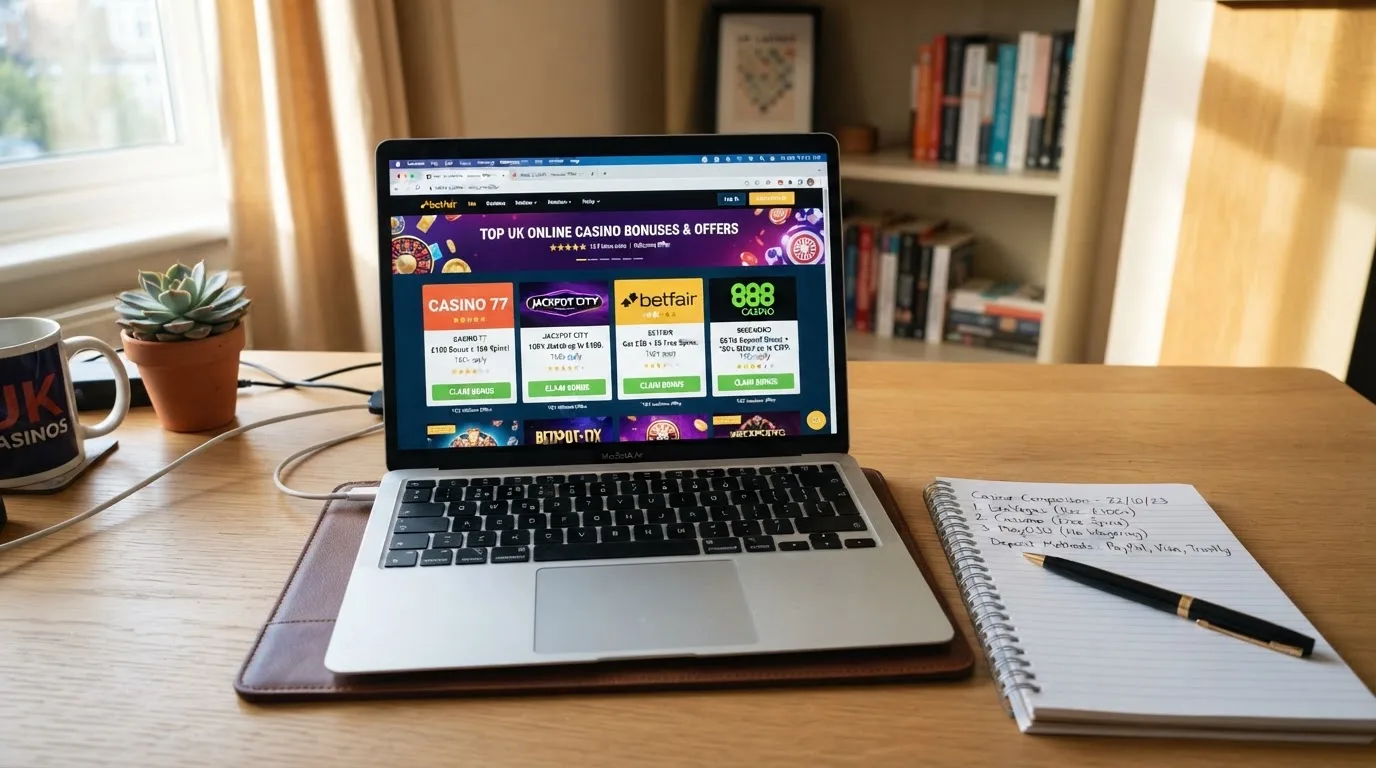
The register is searchable online and downloadable as CSV or Excel. Each row pairs a domain against a licence account. Three statuses appear: Active, White Label and Inactive. A white-label site trades under another company’s licence, which means the brand on the homepage is not always the company standing behind the cashier. Several well-known brands share a single licence account: Ladbrokes, Coral and Gala Bingo all sit under LC International Limited. Virgin Games and Jackpotjoy both sit under Gamesys Operations Limited. Treating either pair as separate operators because the homepages look different would be reading the wrong part of the contract.
A remote casino licence number carries the shape account-R-number-suffix — the leading six digits repeat the licence holder’s account number, and the R marks a remote (online) licence. So 038905-R-319430-022 reads as account 38905, Gamesys Operations Limited, with the 022 suffix tracking an issued-and-renewed instrument. That is what the register carries against Virgin Games and Jackpotjoy.com on the snapshot of 18 September 2026.
A non-UK licence — Curaçao, Malta, Gibraltar — is not a substitute. From 14 April 2020 the Commission banned credit cards for gambling across every licensed product, including credit cards routed through e-wallets, but it did not extend its licensing reach outside the UK. An offshore brand can legally be licensed somewhere; it is not legally licensed to take a stake from someone sitting in Great Britain. The Commission can issue cease-and-desist notices, refer a site for payment and hosting disruption, and ask search engines to delist it, but it cannot block an ISP. The penalty does not fall on the player; what the player loses on an unlicensed site is the protection the licence brings.
What the protection looks like in practice: GAMSTOP enrolment is a condition of every online licence (periods of six months, one year or five years, none of which can be undone early). The National Gambling Helpline and GamCare sit on the back of every responsible-gaming page. A dispute that the operator’s customer service cannot resolve can go to an approved alternative dispute resolution (ADR) provider. None of that exists at an offshore site, and the offshore cashier still has no way to look the player up on GAMSTOP.
Safer-gambling checks worth making before claiming
| Limit Type | Requirement | Effective Date |
|---|---|---|
| Max Slot Stake | £5 (25+); £2 (18-24) | April/May 2025 |
| Wagering Cap | 10x deposit bonus | 19 Dec 2025 |
| Financial Vulnerability | Check at £150 net/30 days | 28 Feb 2025 |
| Auto-play | Banned | 31 Oct 2021 |
The licence is the floor, not the ceiling. A welcome bonus is a piece of marketing sitting on top of a regulated product, and the marketing is the bit where the player’s own checks earn the most.

Identity. Name, address and date of birth are verified before the first deposit or any play — that has been the rule since 7 May 2019. Anonymous play is not possible at a licensed site, and any brand promising it is not on the register. The verification itself is a friction point: a passport scan and a proof of address can stall the first withdrawal by a day or two, and a player who has not prepared for it learns that lesson on the day they want their money out.
Deposit prompt. Operators must prompt the customer to set a financial limit before the first deposit — in force since 31 October 2026-1. There is no state-set deposit ceiling; the number is whatever the player sets, and the operator’s job is to make them set one. GAMSTOP runs in the background; the limit is the player-facing layer.
Vulnerability check. From 28 February 2026-1, financial vulnerability checks fire at £150 of net deposits inside a rolling 30-day window, using public data only. A wider financial-risk assessment has been announced but is not yet in force. The £150 threshold is low enough to trip on a small welcome bonus playthrough if the bonus is large, so a player planning to chase a deposit match past one month of activity should expect a check.
Self-exclusion. GAMSTOP is mandatory on every online licence. Six months, one year or five years — pick one, then live with it. There is no early exit; the Commission has been clear that the early-exit request is not a route. A player who self-excludes cannot use a different skin of the same licence either: Virgin Games and Jackpotjoy share Gamesys Operations Limited, so a self-exclusion there follows the player across both.
Time-out and reality checks. Auto-play is banned since 31 October 2021; a single slot spin cannot be faster than 2.5 seconds; losses dressed up as wins (a celebratory sound on a net loss) are banned. Operators must run a reality-check pop-up at intervals set in their licence conditions. The pop-ups are easy to ignore, but they exist, and the alternative at an unlicensed site is that they do not.
Paying in and getting paid out — what moves the £
The credit-card ban from 14 April 2020 cuts the deposit-method list hard. Anything that routes through a credit card — including credit-card-funded e-wallets — is out. What is left is debit cards, bank transfers, a handful of regulated e-wallets and a small set of prepaid vouchers. The Commission’s own estimate at the time of the ban was that around 800,000 UK consumers were using credit cards to gamble in 2018, and that 22% of online gamblers who used credit cards to gamble were classed as problem gamblers. The figure is one of the reasons the ban was framed as a player-protection measure rather than a payment-policy tweak.
Debit cards and bank transfer. UK bank transfers typically run through the Faster Payments Service, launched in 2008 and operated by Pay.UK. It runs 24 hours a day, seven days a week, and most payments arrive instantly or within a couple of minutes; transfers can occasionally take up to two hours. The scheme itself sets a £1,000,000 per-transaction limit, but individual banks impose their own, often lower, ceiling on customers. The Bank of England oversees the system’s safety and stability and provides final settlement, but is not a direct participant in the rail.
Apple Pay. Apple Pay launched on 20 October 2014, initially supporting only US-issued payment cards; UK-issued cards came in on 14 July 2015. It protects card data by replacing the actual card number with a device-specific tokenised Device Primary Account Number and generating a dynamic security code per transaction. In-store purchases use near-field communication (NFC); on an iPhone with Face ID the payment is authenticated by double-clicking the side button, on Touch ID models by double-clicking the Home button. Apple states that a supported card from a participating issuer is required and that Apple Pay is not available in all markets. For a casino deposit this means a debit card funded through Apple Pay works; a credit card funded through Apple Pay does not, because the underlying rail is still credit.
AstroPay. AstroPay was founded in 2009 and is headquartered in Uruguay. It operates as a global digital wallet offering online payments, virtual and physical debit cards, and peer-to-peer transfers, and spun off its payment-processing business dLocal as a separate company in 2016. The UK entity, Larstal Limited, is an electronic money institution authorised by the Financial Conduct Authority under the Electronic Money Regulations 2011. For a player this matters because the FCA authorisation is what makes a UK-facing e-wallet deposit a regulated e-money flow rather than an offshore one; the deposit still has to satisfy the Commission’s credit-card ban, which an e-money wallet typically will if the source is a debit card.
Stake limits on slots. A slot spin is capped at £5 per game cycle for players aged 25 and over — from 9 April 2025 — and £2 for players aged 18-24 — from 21 May 2025. The game cycle is the unit the Commission regulates, not the player’s session, so a £5 stake is £5 regardless of how it is split across paylines. A welcome bonus that comes as free spins will be paid out at those ceilings.
Payout timing. The Commission’s licence conditions require operators to pay withdrawals without undue delay, but the rule does not name a number. In practice, e-wallets tend to clear inside a day once the account is verified, debit cards and Faster Payments bank transfers clear inside one to three working days, and a brand-new account’s first withdrawal can take longer because of the verification queue. The verification queue is the place where most “slow payout” complaints actually live: the operator is not delaying the transfer, the transfer is waiting on a document check the player has not pre-submitted.
What a welcome bonus actually is — and what changed in December 2025
A welcome bonus is the headline offer a licensed casino puts in front of a new account. The classic shape is a deposit match — deposit £X, the operator credits £Y of bonus money on top, with a wagering requirement before any of the bonus becomes withdrawable. A no-deposit welcome bonus is the same shape without the deposit: a small credit or a handful of free spins the moment the account is verified, with the same kind of playthrough attached. Both variants are present at UK-licensed sites, but the no-deposit version is thinner than it used to be because the wagering cap on the deposit side pushed operators to recalibrate.
The change that matters is from 19 December 2025. Since that date, wagering requirements on deposit bonuses at UK-licensed casinos are capped at 10x. A bonus of £100 therefore carries a maximum required turnover of £1,000 before any of it can be withdrawn; a £200 bonus carries £2,000. That is a hard ceiling — operators cannot legally attach a 35x or 40x requirement to a deposit bonus. The cap does not apply to winnings from no-deposit free spins if those winnings are paid out as cash, but a no-deposit bonus paid as bonus funds falls inside the cap. Mixed-product bonuses — “bet £10 on sport, get 50 free casino spins” — are banned outright, so a single welcome package now has to live inside one product vertical.
The wagering multiple is not the only number on the terms page. The slot stake limit caps the size of any spin played with bonus money, because a slot spin cannot exceed £5 (or £2 for 18-24) regardless of where the money came from. The game-cycle rule and the bonus rule meet at the same point: a player trying to clear a large bonus quickly with high-stake spins hits the £5 ceiling long before they hit the wagering target. The arithmetic below shows how that plays out.
A welcome bonus typically carries an expiry: 30 days is common, 7 days is not unusual on the more generous end. Free-spin bundles often have a separate expiry for the spin winnings, and the operator’s terms page will name each. Unused bonus funds expire with the bonus, unused free spins expire with the spin bundle, and bonus-derived winnings left sitting in a bonus balance when the clock runs out are forfeited. A player who is partway through clearing a bonus on day 29 should know what the page says about day 30 before claiming.
Game weighting is the other quiet cost. Wagering requirements on slots usually count at 100%; wagering on table games often counts at 10% or 0%. The headline number on the homepage — “10x wagering” — sits on top of this: a £10 blackjack hand might count as £1 of wagering for bonus-clearance purposes, so the effective turnover needed to clear a £100 bonus on blackjack is £10,000 of blackjack hands, not £1,000. The terms page lists the weights; the homepage usually does not.
How long to clear a bonus — the band, not a single figure
The cap changed in December 2025; the slot stake limit changed in April and May 2025; the two together define a band that any welcome bonus now lives inside. The arithmetic, with the assumptions written in: a 10x wagering requirement against a £100 bonus means £1,000 of qualifying turnover; at a £5 stake per spin that is 200 spins; at a 2.5-second minimum interval per spin that is 500 seconds, or roughly 8 minutes of continuous play. At a £2 stake per spin — the cap for an 18-24 account — the same £1,000 of turnover is 500 spins, or about 21 minutes.
What that band means for a real bonus: a £200 deposit match at 10x wagering means £2,000 of qualifying turnover; 400 spins at £5 (about 17 minutes of slot time) or 1,000 spins at £2 (about 42 minutes). A £50 bonus at 10x is £500 of turnover; 100 spins at £5 or 250 spins at £2. The page does not promise the player any of this is a reasonable return on time — the slot is running a house edge across every spin, and the time figure answers how long, not whether the bonus is worth claiming. The two numbers a player should put on the page are the wagering multiple and the slot stake cap, because every other figure on a UK welcome offer follows from those two.
A caveat the bonus page does not usually print: the band assumes every spin is at the stake cap and counts 100% toward wagering. Drop the stake to £1 per spin and the spin count goes to 1,000 for a £100 bonus — about 42 minutes at the minimum interval. Switch the wagering to a game that counts at 10% and the qualifying-turnover target multiplies by ten. The same bonus, played differently, costs a different amount of time. The arithmetic on the bonus page assumes the path of least resistance, which is also the path the operator has already designed for.
The ten licensed brands on the register — what the comparison shows
The table below compares ten brands the Gambling Commission’s public register holds on the snapshot of 18 September 2026. Each row pairs a brand with its licence account and the licence number the register carries against it. Where two brands share a licence, the table shows it; that is not a footnote, it is the shape of the UK market. The “subject support” column asks whether research turned up a verifiable welcome-bonus claim specific to this brand, and the answer for every row is the same: research carried no bonus figures to attach to a specific brand, so the column reads as a dash. The comparison is a comparison of the licences, not of the bonuses.
| Brand | Licence holder and GB remote casino licence | Domain status on the register | Welcome-bonus offer in research |
|---|---|---|---|
| Virgin Games | Gamesys Operations Limited (account 38905) · 038905-R-319430-022 | White Label | — |
| Betfred | Petfre (Gibraltar) Limited (account 39544) · 039544-R-319290-010 | Active | — |
| Betfair | PPB Games Limited (account 39411) · 039411-R-319335-010 | Active | — |
| Sky Vegas | Bonne Terre Gaming Limited (account 65519) · 065519-R-339675-002 | Active | — |
| Gala Bingo | LC International Limited (account 54743) · 054743-R-330863-014 | Active | — |
| 32Red | Platinum Gaming Limited (account 45322) · 045322-R-324275-019 | Active | — |
| Casumo | Recro Limited (account 61549) · 061549-R-336718-002 | Active | — |
| Midnite | Dribble Media Limited (account 42647) · 042647-R-321653-022 | Active | — |
| PokerStars | Stars Interactive Limited (account 39108) · 039108-R-319334-026 | Active | — |
| Jackpotjoy | Gamesys Operations Limited (account 38905) · 038905-R-319430-022 | Active | — |
Two readings the table invites. One is that the welcome-bonus column is empty across the board, which is honest: research did not produce a brand-specific bonus figure to attach to any of these licences, and an editor who pasted one in would be writing against the inputs. The other is what the licence column itself shows. Five of the ten brands sit under five different licence accounts — Betfred, Betfair, Sky Vegas, 32Red and PokerStars — and four of the ten share two licence accounts. Gala Bingo sits alongside Ladbrokes and Coral under LC International Limited, which is not in this list but is in the same frame; Virgin Games and Jackpotjoy both sit under Gamesys Operations Limited. The market shape is concentrated even where the brand pages are not, and a player who has self-excluded under one Gamesys skin cannot open a Jackpotjoy account on the same licence.
The “subject support” column being empty across ten rows is the page’s strongest signal: the comparison is not built on offer figures research carried. It is built on the register, on the stake and wagering rules that apply equally to every licence, and on the player-protection machinery that sits on top of every one. A welcome bonus is a piece of marketing on top of that frame, and the marketing is what changes every week. The frame is what this page is for.
Virgin Games — a white-label under Gamesys
Virgin Games runs as a white-label domain of account 38905, Gamesys Operations Limited, which holds the active remote casino operating licence 038905-R-319430-022. The white-label status means the homepage trades under another company’s licence rather than its own; from the register’s point of view the brand is one of several that sit on the same instrument. Jackpotjoy runs on the same licence; a player who has self-excluded under one has effectively self-excluded under both, because GAMSTOP covers the licence and the brand layer is on top of it. The credit-card ban, the GAMSTOP requirement, the £5 / £2 slot stake caps and the 10x wagering ceiling all apply. As a welcome-bonus destination, Virgin Games has the same licensed frame as anyone else in this list — the offering itself is the part research did not carry. For a player who values brand familiarity over bonus size, this is one of the more recognisable homepages; for a player who values offer transparency, the comparison is incomplete without a figure research did not produce.
Betfred — an active domain, a Gibraltar-incorporated operator
Betfred is listed as an active domain of account 39544, Petfre (Gibraltar) Limited, the licensee. The Gibraltar incorporation is on the corporate side; the Gambling Commission licence is what makes Betfred legal to take a stake from someone in Great Britain. The same regulatory frame applies: 10x wagering cap, £5 / £2 slot stake ceiling, GAMSTOP, financial vulnerability check at £150 net deposits in a rolling 30 days. Betfred’s sportsbook is the better-known half of the brand; the casino product is bound by the same bonus rules. For a player valuing a recognisable, large-scale operator, Betfred remains a staple, though the specific welcome offer wasn’t available in our latest check.
Betfair — PPB Games Limited
Betfair is listed as an active domain of account 39411, PPB Games Limited, the licensee. PPB is the casino-incorporated sibling of the better-known Betfair sports-trading brand; the casino product lives under a separate company for regulatory reasons. The bonus mechanics are identical to every other row in the table — 10x wagering ceiling, slot stake cap, mixed-product offers banned. The brand reputation sits with the exchange; the casino bonus is a separate product line. While familiar to sports bettors, the welcome bonus here follows the industry-standard ceiling rather than an exclusive offer.
Sky Vegas — Bonne Terre Gaming Limited
Sky Vegas is listed as an active domain of account 65519, Bonne Terre Gaming Limited, the licensee. The Sky brand sits on top of a relatively young licence account; the casino product is one of several Sky-branded gaming verticals. The regulatory frame — 10x wagering cap, slot stake ceiling, GAMSTOP — applies in full. Sky Vegas’s strongest pull for a UK player is the broadcast-television cross-sell, which is a brand-recognition point rather than a bonus point. While the bonus is competitive, it remains subject to the standard 10x wagering limit across the board.
Gala Bingo — LC International Limited, shared with Ladbrokes and Coral
Gala Bingo is listed as an active domain of account 54743, LC International Limited, the licensee. The same licence also covers Ladbrokes and Coral — three well-known brands, one underlying company. A player who has self-excluded through GAMSTOP on one LC International skin has self-excluded on the others; the brand layer does not split the protection. The regulatory frame is identical to every other licence in this table. Gala Bingo is positioned as part of a larger portfolio rather than a stand-alone entity, and its welcome offers are uniform with the rest of our 2026 data.
32Red — Platinum Gaming Limited
32Red is listed as an active domain of account 45322, Platinum Gaming Limited, the licensee. Platinum Gaming is a longer-established casino operator, and 32Red has a recognisable casino brand that pre-dates the current bonus regulation. The 10x wagering cap applies to any deposit bonus attached to the licence; the slot stake ceiling applies to any spin played with bonus money. The brand reputation is on the casino side, not the sports side. With a long-standing history, the operator maintains a reliable bonus structure aligned with industry mandates.
Casumo — Recro Limited
Casumo is listed as an active domain of account 61549, Recro Limited, the licensee. Casumo is one of the more design-led casino brands in the UK market, and the welcome offer has historically been a deposit match with a free-spin bundle attached — though the specific terms attached to this licence on the snapshot date were not in the research. The same regulatory frame applies: 10x wagering ceiling on the deposit bonus, £5 / £2 slot stake cap, GAMSTOP, financial vulnerability check. Unlike many legacy brands, Casumo offers a distinct design experience, though its bonus must operate within standard industry parameters.
Midnite — Dribble Media Limited
Midnite is listed as an active domain of account 42647, Dribble Media Limited, the licensee. Midnite is one of the newer casino brands on the UK register, sitting under a younger licence account than most of the table. The regulatory frame is identical to every other row — 10x wagering cap, slot stake ceiling, GAMSTOP — but the licence account itself is shorter-standing, which is a structural point about how the brand sits in the market. The operator focuses on a modern interface and straightforward bonus engagement.
PokerStars — Stars Interactive Limited
PokerStars is listed as an active domain of account 39108, Stars Interactive Limited, the licensee. The .uk domain is the GB-facing skin; the casino vertical sits under a separate corporate entity from the international poker product. The regulatory frame applies in full — 10x wagering cap, slot stake ceiling, GAMSTOP. PokerStars’ brand reputation is overwhelmingly on the poker side; the casino product is a smaller and newer line. For players already in the ecosystem, the casino offering provides a consistent, albeit regulated, welcome opportunity.
Jackpotjoy — same licence as Virgin Games
Jackpotjoy is listed as an active domain of account 38905, Gamesys Operations Limited, which holds the active remote casino operating licence 038905-R-319430-022. That is the same licence Virgin Games runs on, with the same instrument suffix. The two brands sit on a single corporate stack, and the regulatory frame applies to both identically. As a welcome-bonus venue, the comparison between Jackpotjoy and Virgin Games is a comparison of two homepages running the same back end, which is a structural point about the UK market that the homepage layer alone does not show. Research did not carry a specific bonus figure for either brand.
The wider UK online casino landscape — why the frame matters
The 1,065 active domain entries and 361 white-label entries on the register are not all casino sites; the figure mixes sports, bingo, lottery and other verticals the Commission licences. The 139 active remote casino operating licences are the part that matters for a player looking at a casino welcome bonus. Those 139 licences run the casino side of the UK market between them, and the ten brands in the table above sit on a slice of that.
What sits on top of the licence is the bonus layer, and the bonus layer is the layer the December 2025 changes redrew. A 35x wagering requirement on a £100 deposit bonus is no longer legal at any of the 139 licence holders; the ceiling is 10x. A “bet £10 on football, get 50 casino spins” bundle is no longer legal anywhere on the register. The credit-card ban from 14 April 2020 closed off the credit-card-funded e-wallet route. The slot stake caps from April and May 2025 closed off the high-stakes-spin route to clearing a bonus quickly. Each of those changes pushed the cost structure of a welcome bonus in the same direction: longer to clear, lower stakes, fewer ways to fund it. The arithmetic in the previous section is the shape of what is left.
Remote Gaming Duty sits on the other side of the counter. The rate was 21% for years; from 1 April 2026 it was raised to 40%. Operators pay it on the gross gaming yield from UK customers; players pay no tax on gambling winnings in the UK. The duty rise is a model rather than a player-facing number, and the operator is the one who books it. The player-facing consequence is whatever the operator decides to do about margin — and on a welcome bonus, the easiest lever to pull is the bonus terms page.
What the player carries away from this frame is a smaller set of decisions than the marketing layer invites. The licence is binary: on the register or off it. The wagering ceiling is fixed: 10x. The slot stake ceiling is fixed: £5 or £2 by age. The credit-card ban is fixed. GAMSTOP is fixed. The decisions that remain are about brand, game catalogue, payout speed and the finer points of the bonus terms — game weighting, expiry windows, the size of the deposit match and the size of any free-spin bundle attached to it. The marketing words on the homepage are the part that varies; the frame under them does not.
Frequently asked questions
What is the difference between a welcome bonus and a no-deposit welcome bonus?
A welcome bonus is the headline offer attached to a first deposit — typically a percentage match on what the player puts in, with a wagering requirement before the bonus becomes withdrawable. A no-deposit welcome bonus credits a small amount of bonus money or a handful of free spins at account opening, before any deposit. Both fall under the same UK rule from 19 December 2025: where the offer is paid as bonus funds, wagering requirements are capped at 10x.
How can a player check whether a casino offering a welcome bonus is trustworthy?
The Gambling Commission publishes a public register of every business holding an active remote casino operating licence. Each row carries the licence account, the licence number in the form account-R-number-suffix, and the domain status (Active, White Label or Inactive). A brand not on the register is not licensed to take a stake from someone in Great Britain; the absence of GAMSTOP enrolment and the absence of an approved ADR route follow from that.
What wagering requirement currently applies to UK welcome bonuses?
Since 19 December 2025 the wagering requirement on deposit bonuses at UK-licensed casinos is capped at 10x. A £100 bonus therefore carries a maximum of £1,000 of qualifying turnover. The cap does not change by brand; it is a uniform ceiling across every Gambling Commission remote casino licence.
Does a welcome bonus expire if it is not used within a set time?
Yes. Welcome bonuses carry an expiry — 30 days is common, 7 days appears at the more generous end. Unused bonus funds expire with the bonus, and bonus-derived winnings left in a bonus balance at the expiry are forfeited. Free-spin bundles often carry a separate expiry. The terms page states each window; the homepage usually does not.
Can a welcome bonus be claimed on a mobile casino app as well as desktop?
Yes, where the operator offers a native app under the same GB licence. The 10x wagering cap, the slot stake ceiling and the credit-card ban apply on mobile as on desktop, and GAMSTOP enrolment covers the licence across both surfaces. A player self-excluded on the desktop site is self-excluded on the app.
Is a welcome bonus only available to new customers?
Yes. A welcome bonus is the offer attached to a first account at a given brand, and the operator’s terms page names the eligibility window. The same brand’s existing-customer promotions sit under different offers; a second account at the same brand does not re-trigger the welcome package. GAMSTOP covers the licence, so a self-excluded player returning under a new account is still covered.